The vehicle handover process is one of the most important moments in the entire fleet management cycle. This is when the company formally transfers the vehicle to the driver or employee, documents its condition, defines the scope of responsibility, and creates the basis for future settlement when the vehicle is returned. Despite the strategic importance of this process, in many organizations it is still based on paper protocols, manual data entry, and scattered photographic documentation.
In practice, this means that one of the most sensitive fleet processes is often carried out in a way that is vulnerable to errors, inconsistencies, and evidentiary gaps. At a time when fleet vehicles are becoming more numerous, more dispersed, and more intensively used, the traditional model of handling vehicle handover and return no longer meets the real needs of organizations.
Vehicle handover as an element of company asset control
A company car is an asset of significant value, which is why handing it over to a user should not be treated only as an administrative activity. It is a process with operational, financial, and evidentiary importance.
A properly conducted vehicle handover should confirm who received the vehicle and when, what technical condition it was in, what accessories and important documents were transferred to the user, what damage existed at the time of collection, and whether the driver accepted the applicable rules for using the car.
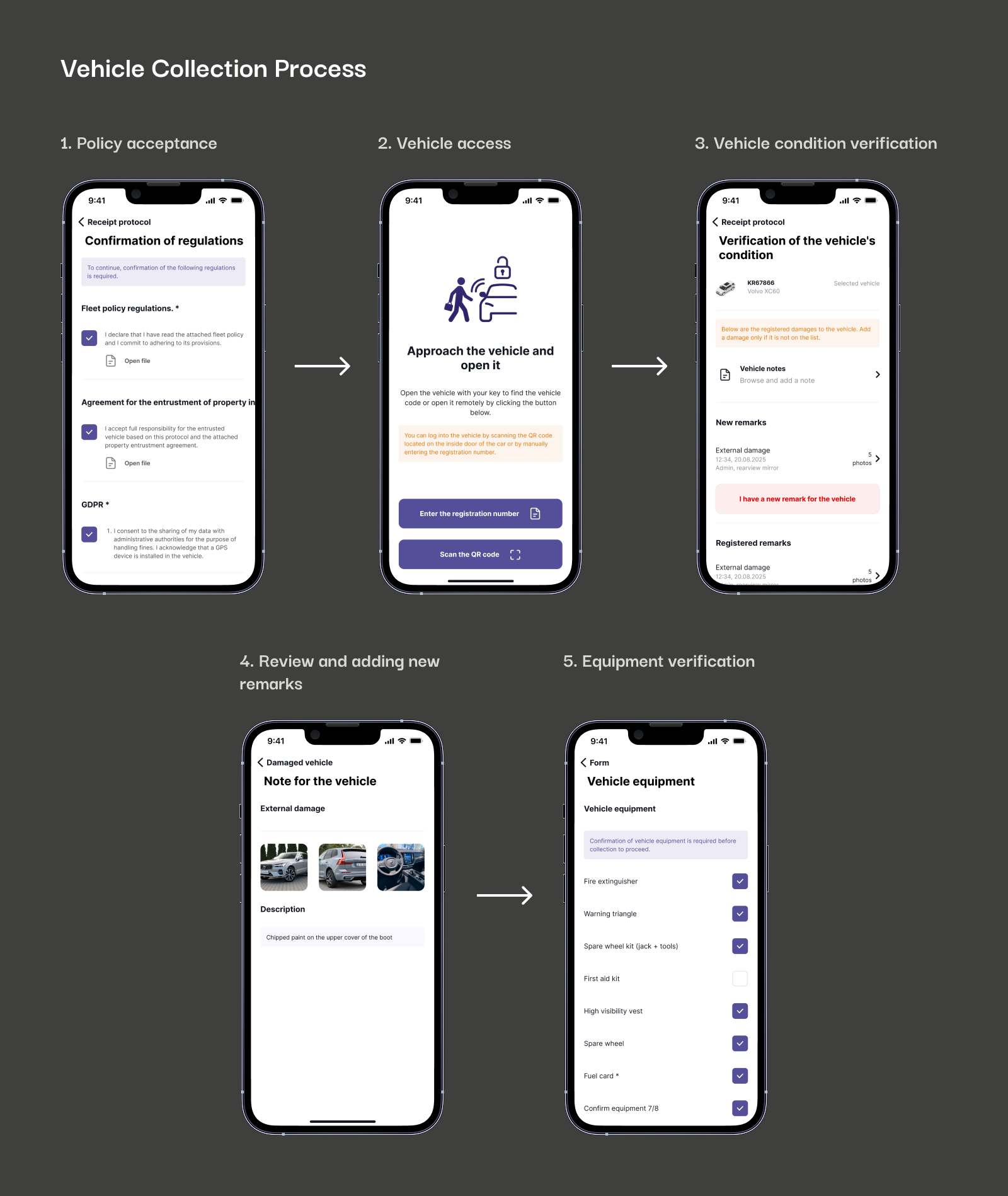
The vehicle handover form should also make it possible to create a clear record of basic information such as driver details, vehicle registration, odometer reading, fuel level, mileage, equipment, and visible defects. Where applicable, the handover form may also include items related to safety and emergency equipment, such as a first aid kit, fire extinguisher, warning triangle, or spare tyre.
A lack of precise documentation at this stage may lead to serious consequences when the vehicle is returned. If the organization does not have a clear confirmation of the vehicle’s condition on the day of handover, it becomes more difficult to prove when the damage occurred, who was responsible for the vehicle during a given period, and whether the driver was properly informed about their duties and obligations.
Limitations of paper vehicle handover forms
For years, the paper protocol was the basic tool for documenting the transfer of a vehicle. Its main advantage was simplicity. However, that same simplicity is now becoming a limitation, especially in organizations managing a larger number of fleet vehicles, multiple locations, or frequent driver rotation.
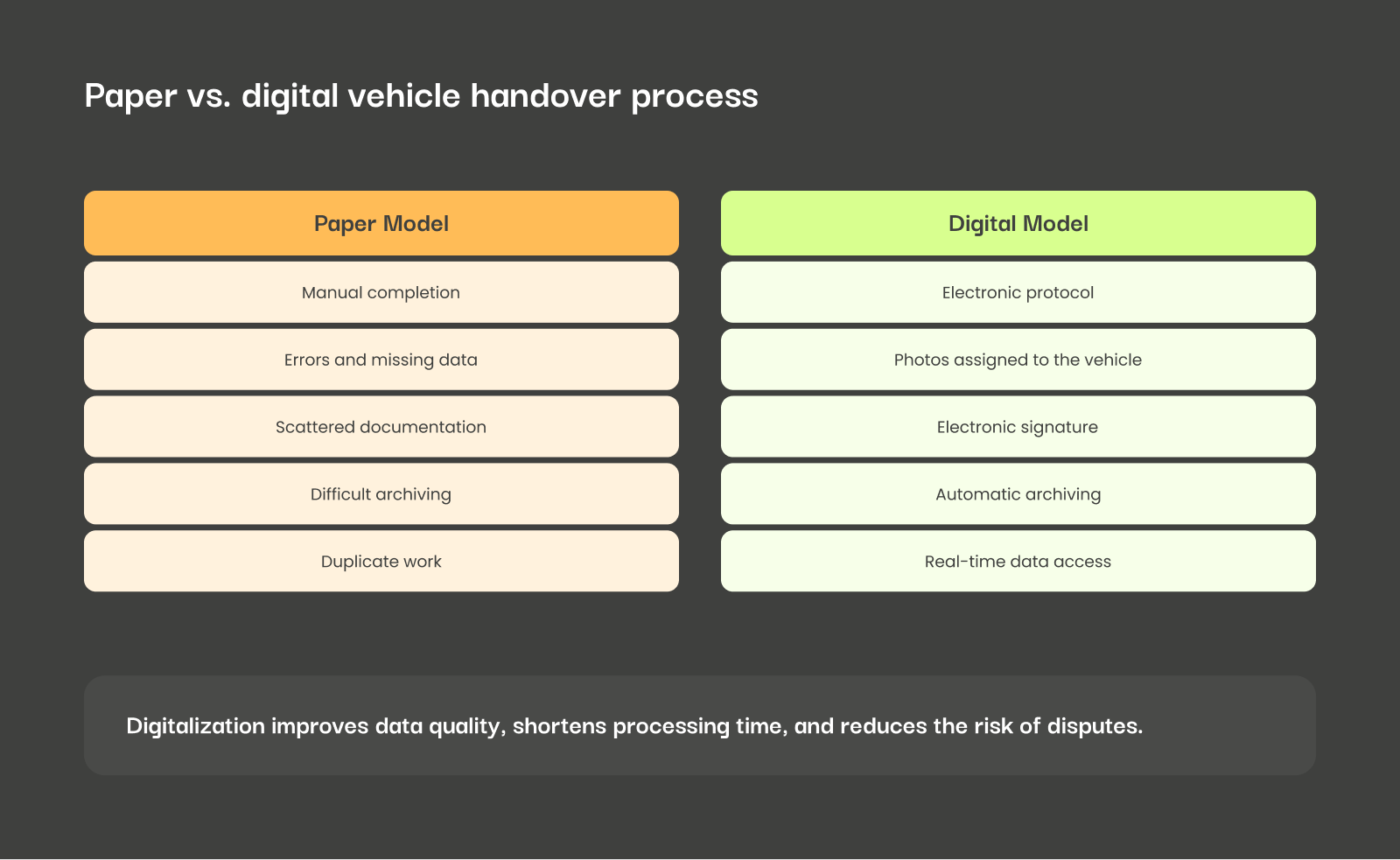
The most common problems related to a paper vehicle handover form include illegible entries, missing mandatory data, unclear descriptions of damage, omitted accessories, difficulty linking photos to a specific handover form, and time-consuming document archiving. Very often, the presence of the fleet manager is also required throughout the entire handover process, which takes time away from other important duties.
It is worth noting that the problem is not only the paper itself, but the entire analogue flow of information. The document may be stored in a binder, photos may remain on an employee’s phone, a scan may be sent by e-mail, and vehicle data may be kept in a separate system. Such a model makes quick access to information difficult and increases the risk that, in the event of disputes, the organization will not have complete documentation.
Data quality directly affects organizational safety and compliance
In fleet management, data is valuable only when it is complete, consistent, and easily accessible. This is especially important in the handover and return process, which often becomes the reference point when assessing the driver’s accountability for the vehicle.
If the handover form contains only general wording, lacks photos, or does not precisely indicate the location of damage, its evidentiary value is limited. The same applies when photographic documentation is not marked with a date, has not been assigned to a specific vehicle, or it is unclear whether it relates to the moment of handover, a later inspection, or another operational event.
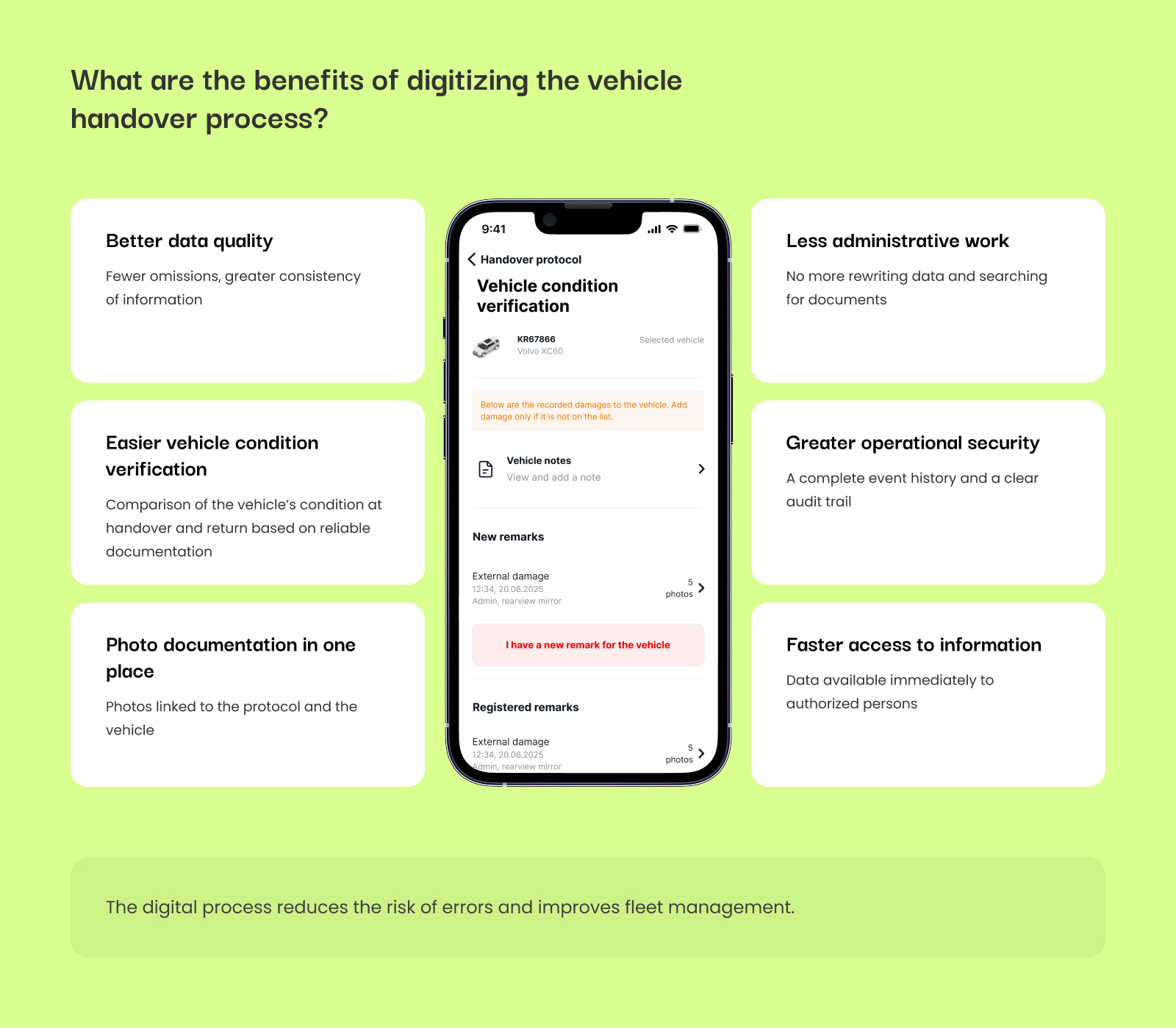
Digitalization of the process significantly improves data accuracy. An electronic vehicle handover form can guide the user step by step, require key fields to be completed, organize the structure of information, and reduce the risk of omitting important elements. As a result, the documentation is created according to a uniform standard, regardless of who carries out the vehicle handover and where it takes place.
A digital form may also support a more detailed record of the exterior condition, interior condition, wheel condition, lights, brakes, dashboard warnings, fuel level, and other elements that are relevant to the condition of the vehicle at the time of handover or return.
Photo documentation as a key element of the handover process
One of the most important elements of a modern digital vehicle handover protocol is photographic documentation. A written description of damage is often not enough, especially when it concerns scratches, dents, damaged rims, glass, interior elements, or additional accessories.
In the traditional model, photos are taken outside the protocol and then sent or stored in different places. This creates a risk of losing the material, incorrectly assigning photos, or being unable to clearly determine when they were taken.
A digital handover process eliminates this problem because photos can be taken directly during the vehicle handover and assigned to specific parts of the vehicle. Such documentation is much more reliable because it becomes an integral part of the handover form and the full handover record. When the vehicle is returned, it allows the current condition to be quickly compared with the condition recorded on the day of handover, reducing the space for misunderstandings and disputes.
Digital vehicle handover protocol and driver accountability
The vehicle handover process should be linked to the broader context of responsibility for entrusted company property. Simply handing over the keys is not enough for the organization to maintain full control over the driver’s responsibility. It is necessary to properly document the handover of the vehicle, its condition, and the driver’s confirmation that they have read the rules of vehicle use, such as the fleet policy, entrusted property agreement, or rules for using a company car for private purposes.
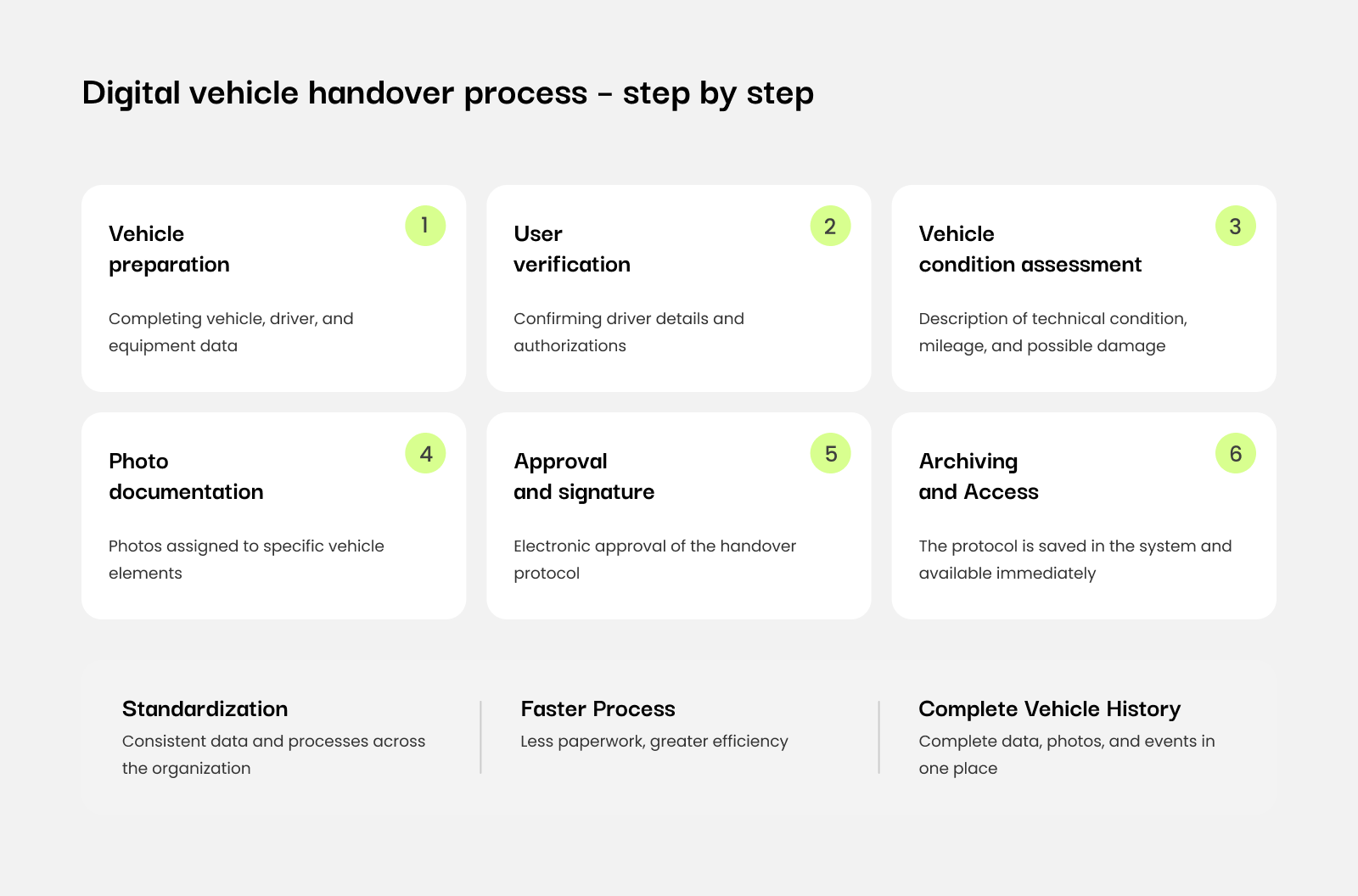
A digital vehicle handover protocol supports this process because it enables all information to be collected in one place in an orderly way. It may include vehicle data, vehicle registration, driver details, odometer reading, fuel level or charge level, equipment, documents, damage, photos, statements, and signatures of the parties.
This gives the organization a full history of the event, not just a scan of a paper handover form. This is important both in day-to-day fleet operations and in disputes, when it is necessary to recreate the history of vehicle use and determine who was responsible for the vehicle at a given time.
Electronic signatures and automatic document archiving
One of the greatest weaknesses of paper document circulation is the need to physically sign, scan, send, and store documents. Each of these stages takes time and increases the risk of an organizational error. A document may be lost, damaged, not scanned, or saved in the wrong place.
Electronic signatures and digital protocols eliminate many of these problems. Once the process is complete, the document can be approved electronically, automatically saved, and assigned to a specific vehicle and driver. Authorized people can access it without searching through archives or contacting other departments.
From the perspective of fleet management, this means greater transparency, shorter service time, and better control over documentation. The process no longer depends on paper, location, or the manual flow of information.
Less operational work, greater fleet manager efficiency
Digitalization of the vehicle handover process also has a direct impact on the efficiency of the fleet manager. In the traditional model, a large part of the time is spent on administrative tasks: preparing the protocol, completing data, reviewing document completeness, scanning, archiving, and later searching for information.
In the digital model, many of these activities are reduced or completely eliminated. Data is entered once, documentation is automatically organized, and the vehicle history remains available in one place. The fleet manager does not have to be involved in every stage of the process to the same extent each time, because the digital tool supports standardization and control of data accuracy.
This is particularly important in organizations where fleet vehicles are handed over and returned frequently, and where the process takes place across different locations. Digitalization makes it possible to maintain one consistent standard regardless of the scale of operation.
Digital handover process as part of mature fleet management
Modern fleet management is not only about monitoring vehicles, controlling fuel costs, or planning maintenance and services. The quality of processes that determine operational safety, driver accountability, compliance, and data availability is becoming increasingly important.
The vehicle handover process is one of the areas where digitalization brings very specific business benefits. It reduces the number of errors, shortens service time, improves the quality of documentation, and increases control over company assets.
The implementation of electronic protocols, photo documentation, electronic signatures, and automatic archiving is no longer a solution reserved only for the largest fleets. It is a standard that all organizations should strive for if they want to manage vehicles in a professional, measurable, and error-resistant way.
Summary: digital vehicle handover as the new standard in fleet management
Digitalization of the vehicle handover process means the end of accidental documentation, scattered photos, and time-consuming circulation of paper protocols. It is a shift from an administrative minimum to an orderly process that supports organizational safety, reduces the risk of disputes, and increases the efficiency of the fleet department.
Companies that want to organize fleet processes, reduce paperwork, and implement a digital model for managing fleet vehicles are encouraged to arrange a conversation and see what fleet digitalization can look like in practice.