In every vehicle fleet, sooner or later the same problem appears: fleet costs start rising not because “everyone is cheating,” but because when there are no clear rules, the system itself creates room for abuse. This is most visible in repetitive areas that are hard to monitor manually and feel “soft” from the employee perspective: fuel costs and fuel expenses, premium services (car wash / concierge), international trips, and “temporary” cars from short-term rental.
If you’re asking how to control a vehicle fleet's costs, start by organising the process. Effective cost control and effective fleet management do not have to mean invasive tracking. They can mean a comprehensive approach based on rules, data, and consequences, giving you real oversight of fleet management costs, operational costs, and day-to-day fleet operations, without harming trust and without generating unnecessary costs.
This article presents a practical control model based on experience with a premium benefit business fleet (around 100 vehicles), where telematics was not implemented due to the fleet’s nature and legal/GDPR risks. At the same time, it shows how vehicle monitoring, live vehicle tracking (when feasible), and analytics can improve operational efficiency, overall operational efficiency, and deliver measurable cost savings, including significant cost savings and substantial savings.
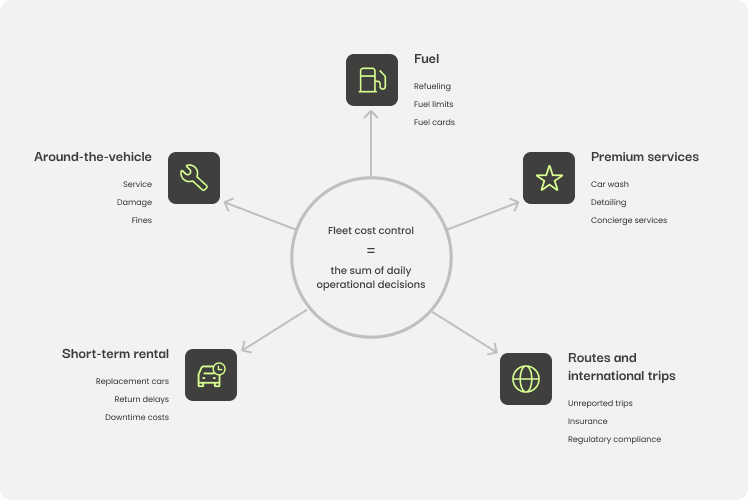
Key areas that drive fleet expenses and operational costs
Most problems are not one large fraud, but repeated small “leaks” that accumulate month after month. That’s why, in practice, the best results come from control focused on key areas and cyclical reporting based on key metrics. This is the foundation of reliable fleet cost analysis and better fleet performance.
1) Fuel costs, fuel consumption, fuel cards, and unauthorized refuelling
The first and most obvious area is fuel. In practice, the issue is rarely one “excessive refuel,” but rather missing system safeguards: too-frequent station visits, volumes that don’t match mileage, extra purchases, and sometimes even the wrong fuel. When a company provides a premium car as a benefit, people naturally use it privately too, but without limits and rules, the fleet's fuel costs can inflate on their own, especially when fuel prices fluctuate.
That is why fuel control and fuel consumption analysis are usually the fastest way to stabilise the budget and reduce costs. The simplest and most effective data source is fuel cards, which support fleet fuel management and help detect unauthorized refuelling, incorrect frequency, suspicious volumes, and patterns that may increase fuel consumption. Proper limits on fuel cards, value limits, volume limits, and purchase categories, are a practical form of fuel management that immediately improves predictability and supports fuel efficiency.
When you align fuel card limits with real mileage patterns across the entire fleet, you can optimise fuel efficiency in a way that is both fair and cost effective. This is also where good fleet management practice matters: consistent rules for mileage entry at the pump, recurring reviews, and a clear escalation path for exceptions. For many fleet managers, this single change delivers quick cost reductions and visible average savings without harming the benefit.
2) “Unlimited” premium services: car wash, detailing, concierge
The second common abuse pattern involves premium services, especially when they are “unlimited.” Car wash, detailing, or concierge services may sound minor, but over a year they become a meaningful part of fleet expenses and other associated costs. Importantly, this does not always come from bad intent, if the management systems allow it, some people will use it more because they can.
Introducing clear monthly limits and simple settlement rules is often the fastest optimisation of fleet management costs. The result is easy to demonstrate: lower spending and stable service quality, meaning cost savings without lowering the standard of the benefit.
3) Unreported routes and international trips: risk management, insurance, and procedures
A third issue is unreported trips, especially cross-border journeys. Here the risk is double: financial risk (mileage, damages, repair expenses, service costs) and formal risk (insurance, assistance, documents). In benefit fleets where routes are not authorised, unreported trips create the largest exposure.
From a compliance and safety perspective, the key is procedures and verifying whether the trip is covered by proper protection, insurance, assistance, and required documents. This directly links to risk management and can also influence insurance premiums. Acting early is usually the most cost effective approach, because one incident can create unexpected expenses that wipe out months of savings and damage the company’s financial health.
4) Short-term rental vehicles: process, contracts, planning, and delays
The fourth category is vehicles from short-term rental. Operationally, it’s a convenient “bridge solution,” but it can be expensive compared to a standard long-term lease payment. If a fleet relies on short-term rentals for months, the budget shrinks with little chance of optimisation.
What matters most here is process discipline: replacement and ordering workflow, planning quality, contract clauses, and managing delay risk (e.g., delivery disruptions). Often, simply tightening the supplier process, tracking deadlines, and planning around operational needs produces noticeable savings and helps cut costs. It also supports better decisions about vehicle acquisition, upfront costs, and long-term planning for vehicle replacement across commercial fleets.
5) Ancillary fleet costs: maintenance, inspections, technical condition, damages
The fifth area includes “ancillary” items: fines, repeated damage, unmanaged servicing. These are not always visible in a single report, but combined, they can represent a large percentage of waste. This is where maintenance costs, maintenance schedules, inspections, and consistent handling of damage claims matter.
In practice, controlling inspection dates and keeping vehicles in good technical condition reduces downtime, improves safety, and supports operational excellence. It also limits wear and tear, reduces vehicle wear, and helps with preventing costly breakdowns and avoiding costly breakdowns that trigger further unexpected expenses and higher operational expenses.
Fleet cost control without “tracking people”: data, reports, and practical monitoring
Control does not start with tools. It starts with whether the organisation can regularly compile data: costs, mileage, refuelling, damages, and service. Even without telematics, you can reach a high level of control if reporting is repeatable and rules are understandable. This is the backbone of practical fleet management in a benefit model and a real driver of better fleet operations.
In practice, you should have at least:
- monthly cost reports (fuel, service, damages, car wash),
- cost-to-mileage comparisons (to detect anomalies),
- control of limits and categories on fuel cards as part of fleet fuel management,
- a simple log of exceptions (business travel, projects, emergencies),
- a service checklist and strict deadline tracking for inspections and maintenance schedules.
This kind of monitoring is not “invasive,” and it often delivers stronger results than expensive deployments of tools without a process, even when you later add fleet management software or partial monitoring features such as vehicle status alerts, limited vehicle location visibility, or event-based analytics.
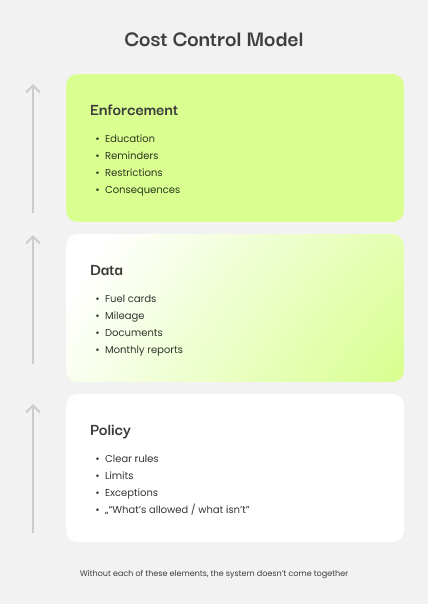
The control ladder: Policy → Evidence → Enforcement
The best abuse-prevention model works like a ladder: it doesn’t start with tools, but with rules and a repeatable process.
Step one is a fleet policy. A good policy should be short and clear. The key is specifics: what is allowed, what is limited, and which exceptions are permitted. Limits based on data—not guesswork—are far easier to defend. In practice, that means analysing invoices and real mileage, multiplying by average fuel prices, and adding a reasonable margin. When a limit comes from real numbers, it supports fair cost control and helps distinguish fixed and variable costs, including fixed costs, variable costs, and each variable expense that grows with usage.
Step two is evidence, process proof without telematics. If the company cannot or does not want to implement GPS route history, the “system” becomes fuel-card data, protocols, document flow, and mileage records. Consistency matters: one spreadsheet changes nothing; routine changes everything.
In practice, a simple process is enough: at refuelling the driver enters mileage, the fleet team compares costs and mileage monthly, and fuel card limits reflect how vehicles actually move. For premium services it’s similar: if the car wash or concierge was “unlimited,” introducing a monthly limit stabilises spending while maintaining the benefit.
A surprisingly effective “analog” control for international trips is document gating: key documents (e.g., registration certificate, insurance policy) are stored by the fleet team and issued only when the employee reports the trip. This forces notification, avoids privacy issues, strengthens compliance, and reduces risk without creating a sense of surveillance.
Step three is enforcement. Without enforcement, even the best policy is only a document. The most effective approach is progressive: first education and reminders, then limitation of privileges (e.g., blocking foreign transactions on the fuel card, restricting purchase categories, limiting car wash use), and only then formal consequences for repeated behaviour. The goal is not to punish, but to maintain consistent rules.
Fleet management and operational efficiency: roles of fleet managers, line managers, and drivers
In a model without telematics, the role of fleet managers becomes critical because they connect the data into a coherent picture. The strongest operating set is: fuel cards as a data source, regular analysis of costs and mileage, and document processes (protocols, travel rules, service checklist). This does not have to be heavy administration as long as the process is repeatable and not reinvented each time.
A clear division of responsibility works well:
- the Fleet Manager owns the process, limits, reporting, and standards across the entire fleet,
- line managers support enforcement and communication of rules,
- drivers get a clear instruction: what to report, when, and how.
A practical add-on that reduces costs and risk is short training: refuelling rules, settlements, damage reporting, and safe driving. Strong driver training programs and ongoing driver training influence driver behaviour, support safe driving practices, reduce damage frequency, and can help achieve lower insurance premiums over time. They also reduce repair expenses, limit downtime, and improve the vehicle's lifecycle.
Real-time monitoring and telematics: a tool for fleet performance, not the goal
If a company can implement telematics, it helps to treat it as analytics rather than “watching routes.” GPS and vehicle monitoring can be modular: instead of full routes, it may focus on events (harsh braking, acceleration, impacts), geofence alerts, and vehicle status. Then monitoring runs in the background, supports efficient management, and enables response to risk without intruding on privacy.
A major advantage is real-time operation and access from anywhere, supporting quicker anomaly detection, better planning, and smoother route planning and route optimisation, especially when the fleet supports projects and deadlines. Over time, this also enables smarter maintenance planning, including predictive maintenance, which helps avoid breakdowns, manage wear and tear, and reduce the risk of excess downtime.
The biggest value appears when data correlates: fuel, mileage, damages, and servicing create a consistent story. But that only works when the base process is already functioning; otherwise telematics becomes yet another data stream without decisions.
Full cost control comes from process, not a “magic tool”
Fleet abuse usually comes not from deliberate fraud, but from missing rules and inconsistent follow-through. The most effective control model is surprisingly simple: a clear policy, evidence through data and documents, and consistent enforcement. Telematics can help, but it is not a requirement, especially in benefit fleets where privacy and compliance matter.
If you start with one thing, start with fuel and “unlimited” premium services. That is the fastest way to stabilise the budget, generate significant savings, reduce costs, and clearly demonstrate cost impact to finance and leadership as the result of structured fleet management, disciplined control of operational costs, and better decisions on utilisation, whether that means improving vehicle utilisation, addressing excess vehicles, or strategically reduce fleet size where it makes business sense. Hybrid choices (e.g., hybrid vehicles) can also be part of a broader strategy, but only when the basics, rules, data, and accountability, are already in place.