In fleet projects, a GPS device is not an end in itself. It is a data source used to build control over vehicle utilization, safety, accountability, and fast incident response. Well-selected hardware must be reliable, serviceable, and cost-predictable while also ready for technology shifts, such as Europe’s migration from 2G to 4G.
Below is our approach to Teltonika devices for fleets up to 3.5 tonnes: which models we use day to day, which additional solutions are worth considering, and how our partner collaboration with the manufacturer works in practice.
Teltonika devices we work with every day
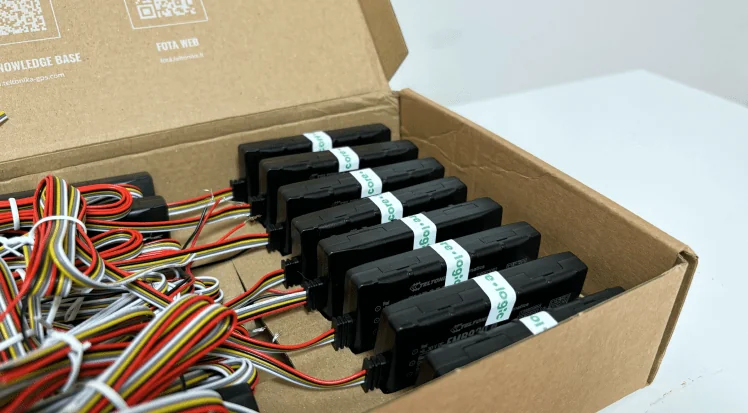
In day-to-day fleet deployments, we use three core Teltonika models from the FM platform:
- FMC920 – a 4G device installed permanently (wired into the vehicle’s electrical system).
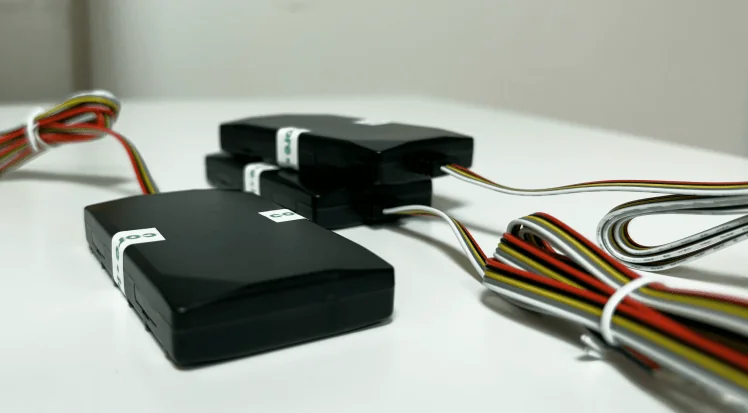
- FMC800 – a 4G device plugged into the OBD2 port (fast and simple installation).
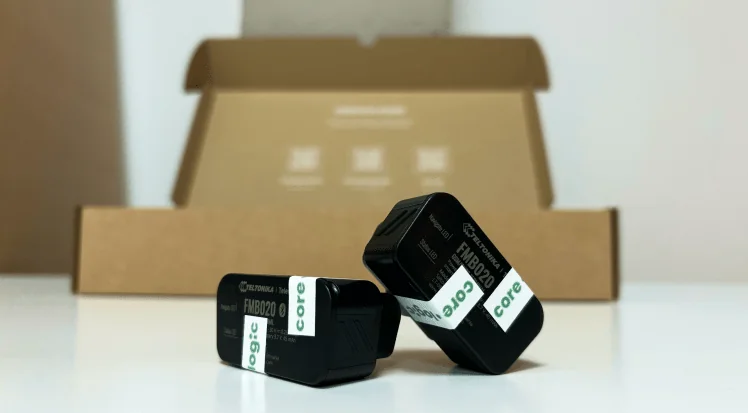
- FMB020 – a 2G device for OBD2 (very compact, rapid rollouts), which we now treat as a transitional solution due to changes in network infrastructure.
In practice, the key point is that devices in this class deliver a consistent, predictable feature set; they differ primarily in installation method and the operational implications that follow.
What standard telematics actually delivers for a fleet
For fleets up to 3.5 tonnes, the fundamentals are data that is easy to operationalize in processes and reporting:
- vehicle location and route history,
- dynamic events from the accelerometer (3-axis acceleration) enabling detection of harsh braking, harsh acceleration, and abnormal motion patterns,
- with OBD2 installation: selected operational data (e.g., mileage, selected fuel parameters—depending on the vehicle and what is available for reading).
This is the foundation for building services and automation: from utilization control and event monitoring to billing, trip verification, and compliance.
Installation matters: OBD vs. hardwired
In a fleet environment, installation is just as important as device specifications:
- OBD2 – fastest rollouts, easier servicing, minimal vehicle intrusion.
- Hardwired (cabled) installation – more discreet, mechanically stable, and offers greater control over device placement.
With OBD2, ergonomics also matter. 4G OBD devices are physically larger than their 2G equivalents, which can be noticeable in the cabin (visibility, protrusion, risk of accidental knocks). In large fleets, this “small detail” can materially affect driver satisfaction and reduce mechanical incidents around the device.
Why we are consistently moving to 4G
The sunset of 2G in Europe is not a single switch-off moment—it is a phased process that varies by country and operator. For fleets operating internationally, this creates a risk of temporary loss of live visibility in markets where 2G is already unavailable, even if 2G still works in Poland.
Devices can buffer data and upload it once coverage returns, but that does not replace real-time monitoring. That is why, for multi-year fleet contracts, 4G is the safer and more future-proof choice.
In Switzerland, 2G has already been switched off. In many other markets, timelines extend into the second half of the decade: in Germany, Deutsche Telekom indicates 30 June 2028; in France, Orange refers to shutdown by the end of 2026; in Finland, 2G is expected to remain available until the end of 2029; and in Norway, operators provide varying dates (from 2025 to 2027). Poland is generally seen as being toward the end of the decade—there is no single nationwide date, but the most commonly referenced horizon is roughly 2028–2030, depending on the operator and the pace of IoT/M2M migration.
The newer FT platform and dead reckoning: accuracy when GPS fails
More advanced Teltonika models offer dead reckoning—estimating vehicle position when GPS signal is lost (tunnels, underground parking, dense urban areas).
This provides:
- smoother routes (fewer “jumps” and distortions),
- higher data reliability for geofencing and billing,
- better information quality in urban environments.
This is particularly valuable where trace accuracy has direct business impact (e.g., visit confirmations, route-based billing, automated geofence events). It is important to note that higher precision typically comes with a higher device cost—best justified when the organization can actively use that additional quality.
Backup tracker: an additional layer of vehicle protection
One of the more effective approaches to fleet security is a two-layer setup:
- the primary tracker provides standard monitoring,
- an additional hidden, battery-powered unit acts as a backup and starts transmitting when it detects the primary tracker is missing (e.g., unplugged, sabotaged, or failed).
This makes strong sense for fleets exposed to theft and tampering. It is also practical: the hidden tracker operates in a low-power mode and “wakes up” only when needed. In return, it requires an operational response plan, because recovery mode is constrained by battery capacity.
CAN and deeper telemetry: more data, more complexity
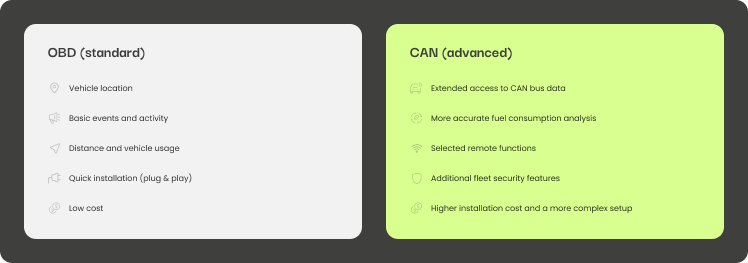
The CAN bus (Controller Area Network) is the communication backbone of modern vehicles. It connects control units and enables reading and analyzing onboard computer data in real time. With CAN access, it becomes possible to deliver detailed diagnostics (warning lights and fault codes, service suggestions, tire-pressure monitoring, seatbelt status, door open/close states), and even remote control of vehicle functions such as climate and heating, lights, or central locking.
CAN can also support additional security features, including remote ignition immobilization, vehicle locking, or audible alerts—and in more advanced solutions, keyless access and full remote operation. For drivers and fleet managers, operational data is equally valuable: direct fuel consumption readings, fuel fill tracking and anomaly detection, advanced ECO analytics (e.g., accelerator behavior, engine RPM, braking), and building a vehicle “knowledge base” (mileage, consumption, location, road events), which can ultimately support predictive maintenance and cost forecasting.
However, CAN integration increases both cost and deployment complexity: it requires more specialized installation, more time, and often additional system components. For fleets up to 3.5 tonnes, CAN is worth considering when the goal is advanced operational analytics and vehicle data depth.
Not every fleet needs the most technologically advanced device. At the same time, there are scenarios where going beyond standard makes sense—especially when a company plans to develop services based on data, or operates in a higher-risk environment.
Installation accessories: simple improvements, significant impact
In many fleets, optimization comes not from changing the device, but from solving deployment friction: OBD extension cables, adapters, a proven installation standard, or dedicated components that improve ergonomics. This is often the fastest way to combine speed of installation with driver comfort.
What does working with Teltonika look like in practice?
Our relationship with the manufacturer is built on a long-term, volume-based model.
Platinum Partner status confirms scale and translates into tangible benefits:
- better commercial terms,
- more predictable planning of deliveries and model availability,
- faster alignment on commercial conditions for larger volumes.
In fleet projects, this is critical: unit price is only one part of total cost, but at scale it matters—and supply chain predictability directly determines rollout timelines.
Operating model: planning, purchasing, deliveries, account support, and market know-how
At larger volumes, supplier management requires planning ahead—sometimes quarterly, and even annually. The purchasing process is straightforward and transparent: order, settlement, delivery. Most importantly, we deliberately limit the number of device models we deploy, which allows us to maintain consistent installation practices, configuration, and service.
In practice, access to manufacturer expertise also matters. The partnership goes beyond hardware supply and includes deployment consultations, recommendations for installation accessories, and knowledge from other markets and projects. This speeds up the resolution of typical fleet challenges: installation ergonomics, accessory selection, installation standardization, and preparation of variants for different vehicle makes and models.
Technology should serve services—not the other way around
For fleets up to 3.5 tonnes, the best outcomes come from a practical approach:
- choosing hardware resilient to technology change (4G as the default),
- focusing on data that directly supports real processes,
- standardizing device models and installation to scale efficiently,
- using “beyond standard” options (dead reckoning, backup tracker, CAN) only when there is a clear business objective.
That combination of hardware competence and deployment experience is what turns telematics from “a GPS locator” into a tool for managing fleet operations, risk, and cost.