.png)
Fleet management is no longer limited to monitoring inspection dates, insurance policies, fuel cards and mileage. A company’s fleet is now an operational environment where data, people, costs, driver safety, procedures, documents, service processes, vehicle usage policies and business expectations all meet. That is why a complete fleet management system should support not only vehicle administration, but also effective process management, cost control and driver management.
Modern companies need more than a tool for tracking vehicles on a map. They need a platform that organises the daily work of fleet managers, supports drivers, automates repetitive administrative tasks and enables decisions based on reliable fleet data. In practice, this means better organisation of fleet operations, current access to key information and greater transparency in the use of company vehicles.
FleetOnAir is such a solution — comprehensive fleet management software for fleet operations, telematics and the digitalisation of fleet processes. Its greatest value is not a single function, but the combination of many modules in one coherent ecosystem: from GPS tracking and driver behaviour analysis, through digital vehicle handover protocols, fleet calendar and pool cars, to integrations with financial, accounting, ERP, HR and operational systems. This approach responds particularly well to the needs of organisations that want to develop fleet management in a structured, measurable and scalable way.
FleetOnAir does not replace the fleet manager. This distinction is important. The platform does not “manage the fleet” on its own, independently of the organisation. It provides tools, data and automation that allow the fleet manager to spend less time on administrative tasks and more time on analysis, optimisation and decision-making. This is why the solution is valuable support for fleet managers responsible for safety, fleet costs, vehicle performance and overall operational efficiency.
Fleet compliance and digital processes: less paper, more control
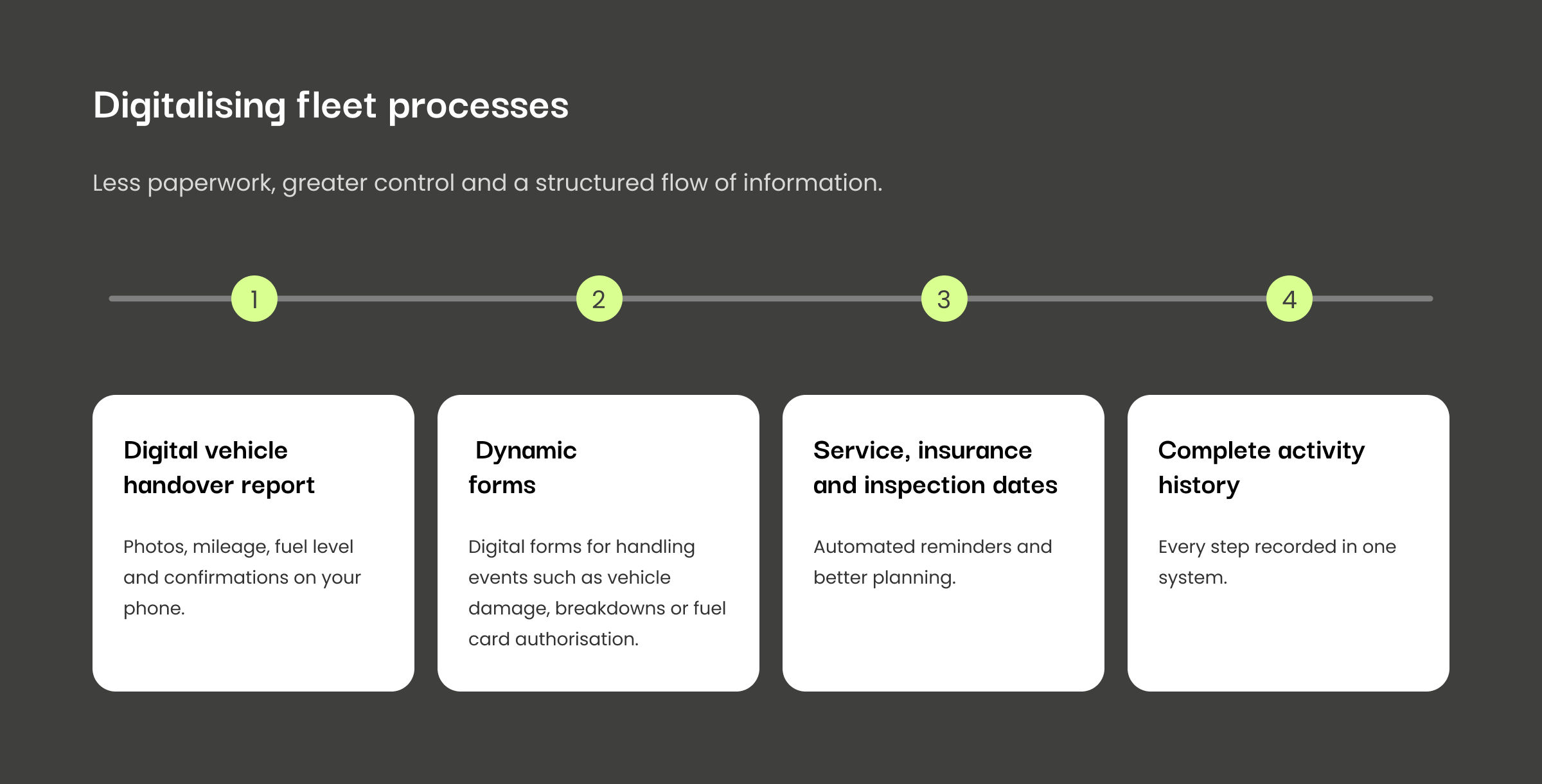
One of the main areas in which FleetOnAir organises fleet work is the digitalisation of processes. In many organisations, vehicle handling still depends on Excel spreadsheets, emails, paper protocols, photos sent from mobile phones, handwritten notes and documents stored in different places. The problem appears when it is necessary to quickly determine who used a vehicle, what condition the vehicle was in when it was handed over, when the last service was completed, whether the driver reported damage or whether a technical inspection deadline is approaching. In such an environment, effective document management, fleet compliance and control over vehicle usage become key operational challenges.
FleetOnAir transfers these processes into a digital environment. The vehicle handover and return process is especially important. Instead of paper protocols, handwritten signatures, document scanning and later archiving, the user can complete the whole process through the mobile application. They can confirm receipt of the vehicle, prepare photographic documentation, report damage, accept vehicle usage rules and close the process in an organised way.
The mobile application also acts as a knowledge centre for the driver. The user can find fuel card details, the insurance policy or a scan of the registration document. Through the application, the driver can also report tyre replacement, confirm vehicle maintenance, report that a service has been completed or ask the fleet manager to assign a fuel card to a replacement vehicle. In an emergency, the driver has quick access to the driver handbook, which includes the most important emergency numbers and procedures.
For the fleet manager, this means less work on repetitive tasks and greater confidence that the data is complete. For the organisation, it means better documentation, a lower risk of disputes and more control over fleet assets. For the driver, it means a clear and simple process available on a phone. It is also an operating model that strengthens fleet compliance, clarifies user responsibility and helps detect irregularities faster.
This is not only a matter of convenience. A digital flow of information improves the quality of vehicle data. If a vehicle handover protocol includes photos, date, mileage, fuel level or battery charge level, equipment, damage and user confirmations, the company has a much more complete picture of the situation. When a vehicle is returned, damaged or disputed, it is easier to compare its condition at the moment of handover with its condition at the moment of return. Such accurate process monitoring reduces the risk of mistakes and gives the organisation full control over the history of vehicle usage.
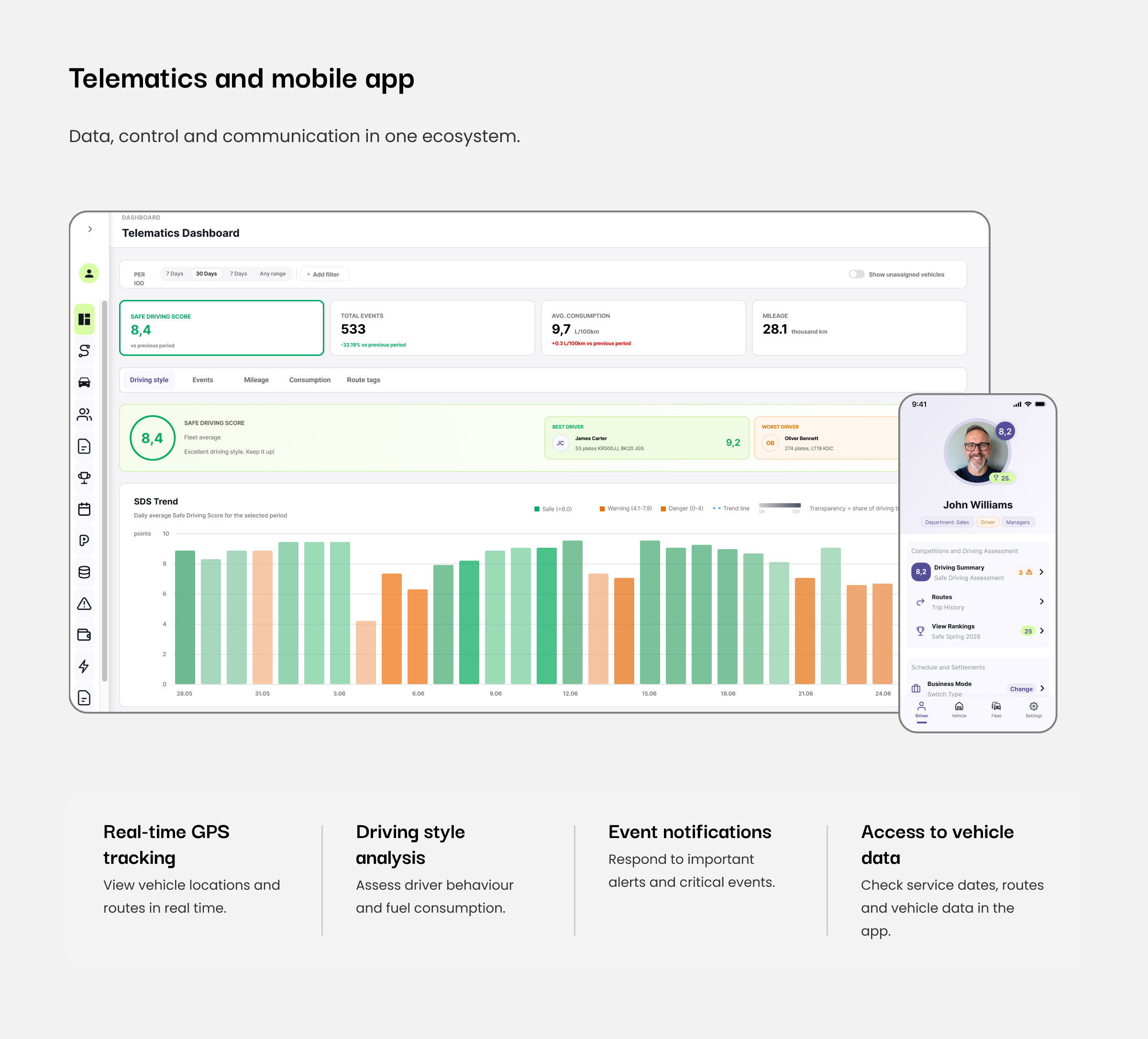
GPS tracking, vehicle tracking and fleet data as the foundation of better decisions
Telematics is one of the most important modules of FleetOnAir. In practice, however, it is not only about checking where a vehicle is located. GPS tracking is the starting point, but the real value appears only when vehicle data is connected with processes, fleet policy, the mobile application, reports and business decisions. In this approach, telematics and GPS tracking systems become the foundation of modern fleet management, not just a tool for vehicle location.
FleetOnAir makes it possible to collect and analyse data on routes, mileage, speed, fuel consumption, driver behaviour, road events, harsh braking, acceleration and speeding. As a result, the fleet manager does not have to rely only on declarations, intuition or scattered reports. They can work with facts, analyse fleet data and use information from real time tracking and vehicle monitoring.
Telematics helps answer specific questions:
- Are vehicles being used according to their intended purpose?
- Are there excessive private mileages?
- Does driver behaviour increase fuel consumption?
- Do some vehicles generate disproportionately high maintenance costs?
- Can some routes be improved or shortened?
- Do driver habits increase the risk of damage?
- Is fuel card data consistent with the actual use of the vehicle?
- Can route planning reduce empty mileage, stops or idling?
- Does real time tracking allow the organisation to respond faster to events on the road?
This approach changes the way companies talk about fleet costs. Instead of saying generally that “our costs are high”, the organisation can see exactly where deviations appear: in fuel consumption, routes, driving style, servicing, excessive mileage, downtime or the way company vehicles are used. In road transport, transport companies, sales fleets, courier businesses and organisations with dozens or hundreds of vehicles, these actionable insights can directly support operational efficiency.
Driver safety and driver behaviour: safe driving and gamification
One practical use of telematics is driver behaviour monitoring. FleetOnAir supports the analysis of behaviours such as harsh braking, dynamic acceleration, speeding and excessive fuel consumption. Driver behaviour analysis helps organisations understand which habits affect driver safety, vehicle condition and fuel costs.
However, telematics should not be perceived as a tool for excessive control. The presence of a system alone does not change behaviour. Data becomes useful only when the driver understands what is being measured, why it is measured and how they can improve their results. That is why good fleet management solutions should not only collect data, but also present it in a clear, understandable and practical way.
This is where the mobile application plays an important role. The driver receives information after a route, sees their statistics and can understand which behaviours affected the score. If the system shows where harsh braking or speeding occurred, it is easier to move from an abstract assessment to a specific improvement in driving style. This quick response supports driver safety, helps enhance safety across the fleet, reduces the risk of damage and limits unnecessary fuel consumption.
Gamification is also important here. Driver behaviour scores can be used as a motivational element, individually or in teams. Drivers can compare results, compete for rewards or take part in safety improvement programmes. This model works better when it is based not on punishment, but on transparent rules, education and incentives. In this way, the organisation can strengthen driver responsibility and build a culture of safe driving practices.
Another direction is linking safe driving with the settlement of private trips. For example, the safer and more fuel-efficient the user drives, the more favourable the conditions for settling private mileage may be. This mechanism connects the organisation’s interest with the driver’s real motivation. In a broader perspective, it translates into business benefits: lower wear of parts, lower operating costs and greater safety across the entire fleet.
Driver management and the mobile app as a knowledge centre
FleetOnAir is not limited to vehicle tracking or fleet administration. A very important part of the platform is the mobile application for drivers. It connects telematics data with daily vehicle usage and allows drivers to access key information in one place.
A driver should not have to search through emails, call the fleet manager about every issue or wonder what to do in the event of damage, service or breakdown. The application acts as a knowledge centre for the vehicle and the rules of its use. An intuitive interface and current access to data make everyday work with a company car simpler and more organised.
Through the application, the driver has access to the most important information: vehicle data, instructions in the event of damage, service contacts, fuel card information, the history of reported damage, inspection dates, insurance policies, technical inspection deadlines and reminders about actions to be completed. Depending on the organisation’s needs, the mobile application can also support route monitoring, fault reporting, task confirmation and communication about the technical condition of the vehicle.
This reduces the number of repeated phone calls and emails, where the fleet manager is flooded with the same questions. The driver gains quick access to information, while the fleet manager can focus on more strategic work: analysing costs, planning service activities, improving processes and controlling fleet usage. For fleet managers, this means better information order and more efficient management of daily operations.
Fleet maintenance, vehicle maintenance and maintenance scheduling in real time
Another important element of FleetOnAir is the fleet calendar. This module organises deadlines related to vehicle maintenance: inspections, technical tests, insurance policies, servicing, replacement of wear parts and consumables, including tyres, repairs, workshop visits and mileage-based tasks. Such a solution supports fleet management because it allows organisations to plan technical maintenance and reduce the risk of missing important deadlines.
In the traditional model, much of this information is stored in spreadsheets, emails, notes or external systems. This increases the risk of overlooking a deadline, delaying service or lacking current information about the vehicle’s condition. FleetOnAir collects these details in one place, which makes monitoring, work organisation and control over fleet maintenance easier.
The system reminds users about upcoming actions, and the driver can confirm completion of a specific task through the application. They can also add a photo, invoice, note or report. The fleet manager sees the status in the panel and can react faster. As a result, vehicle maintenance is handled in a more structured way, while decisions about servicing, inspections and repairs can be made on the basis of current data. The system is integrated with CEPIK and UFG databases, which allows it to automatically download data on technical inspection dates and the validity of insurance policies.
The fleet calendar is not only administrative. Properly managed maintenance scheduling affects driver safety, vehicle uptime, service costs and the predictability of fleet operations. If a company knows when an insurance policy expires, when a technical inspection is required and which vehicles need servicing, it is easier to plan the budget and reduce vehicle downtime. For fleets consisting of passenger cars, trucks and, in selected organisations, specialist assets such as forklifts, systematic deadline management can be particularly important for operational continuity.
Fleet operations, pool cars and corporate carpooling
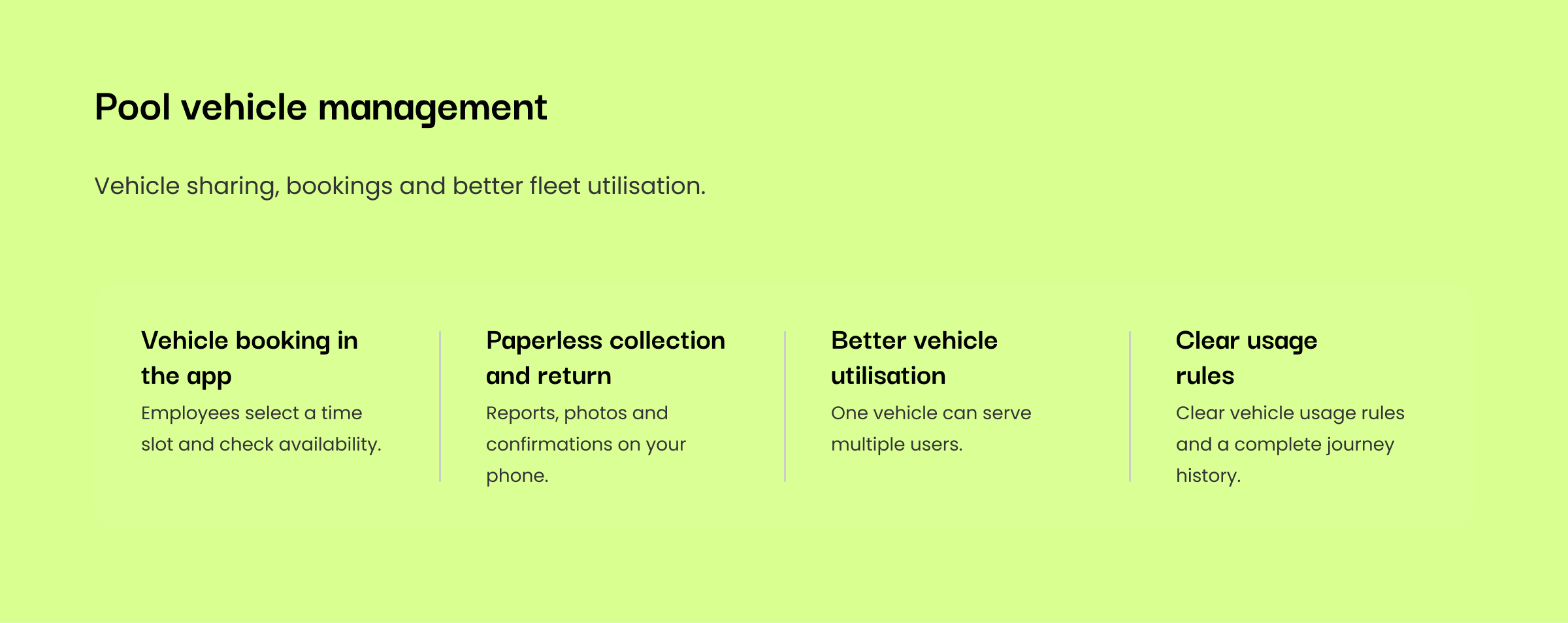
FleetOnAir also supports the management of pool cars. This is a model in which a vehicle is not permanently assigned to one person, but can be shared by many users according to the organisation’s rules. In companies where the fleet is intensively used by different departments, such a module improves fleet performance and vehicle usage.
In practice, an employee reserves a car in the application, selects a time slot, checks availability, collects the vehicle, completes the handover protocol and returns the car to a defined location after the trip. It is also worth emphasising that access to the vehicle is keyless, while opening and closing the car is possible directly from the mobile application. The system supports user roles, permissions, business and private trips, return zones, usage reports and settlements. As a result, the organisation gains a tool that supports efficient management of vehicle availability and reduces the chaos connected with reservations.
For companies, this means better use of fleet assets. A car that previously remained parked for most of the day can serve several users. The organisation can reduce the number of vehicles purchased “just in case”, plan availability more effectively and analyse the real utilisation of the fleet. In practice, this translates into better organisation of fleet operations and more rational vehicle acquisition or leasing decisions.
Corporate carpooling works well with telematics. Thanks to data on location, routes, usage time and vehicle condition, the company has greater control over who uses a car, when, for what purpose and in what condition they return it. This increases user responsibility, makes settlements easier and reduces operational disorder. GPS tracking and current vehicle tracking also help determine vehicle availability and vehicle location quickly, which is especially important in distributed organisations.
Fleet costs, cost control and fleet management software cost
A modern fleet generates a large amount of cost data: fuel, energy, service, repairs, insurance, parking fees, tolls, damage, downtime, mileage, depreciation, leasing, rental, fines, car washes and operating costs. If this information is scattered, it is difficult to assess the real cost of using a vehicle and manage fleet costs effectively.
FleetOnAir acts as an administrative and cost management tool that collects vehicle data and allows it to be analysed together with telematics and the driver application. This is especially important in larger organisations, where vehicles are assigned to different departments, projects, branches or cost centres. In such cases, fleet management requires not only records, but also data comparison, deviation analysis and assessment of operational efficiency.
In practice, the system helps allocate costs to the correct cost centre, department, user or project. If telematics data shows who used the vehicle, when and for what purpose, and the driver application allows business and private trips to be marked, settlements become easier to organise. In this way, the platform supports both fuel management and the analysis of expenses related to service, vehicle maintenance and private use.
This area has great strategic importance. It does not always generate immediate savings visible from one day to the next, but it builds a data-driven work culture. The company can better understand its cost structure, identify deviations and compare vehicles, users, departments and types of usage. In practice, analysis of data from the whole fleet makes it possible to take better decisions and plan the budget more consciously.
Integrations with partners and external systems
The comprehensive nature of FleetOnAir also comes from its ability to integrate with other systems. A fleet does not operate in isolation. It is connected with accounting, finance, HR, ERP systems, CRM systems, fuel card providers, parking operators, car washes, toll systems, service providers and reporting platforms.
That is why fleet data should be able to flow between tools. Integrations reduce manual data entry, lower the number of mistakes and accelerate settlements. In modern transport and in organisations with a large fleet, such connections are the foundation of effective information management.
Example integration areas include:
- financial and accounting systems,
- ERP systems,
- HR systems,
- fuel cards,
- parking systems,
- toll operators,
- service systems,
- reporting and analytics tools,
- solutions provided by operational partners.
As a result, FleetOnAir becomes a central point for fleet data. It does not only display information in a panel, but also sends it further to the places where it is needed — accounting, controlling, administration, HR or operational departments. This is particularly important for transport companies, courier businesses, service companies and organisations in which fleet management requires data consistency across many departments.
Reduce fuel costs, reduce fuel consumption and improve operational efficiency
In communication about fleet management solutions, it is easy to exaggerate and promise specific percentages of savings. In practice, every fleet is different. A company with 50 vehicles in rental and external CFM service works differently from an organisation with 200 vehicles financed through leasing and managed internally. Differences concern the number of users, mileage, cost structure, fleet policy, vehicle usage model and process maturity.
That is why it is better to talk about optimisation potential than fixed promises. FleetOnAir helps identify areas where costs can be reduced: fuel, excessive mileage, driver behaviour, service, damage, private use, downtime, inefficient vehicle usage and administrative mistakes. In practice, GPS tracking, driver behaviour analysis, route monitoring and vehicle performance data can support efforts to reduce fuel costs and manage fleet usage more consciously.
Fuel consumption is a good example. If, with typical fleet mileage, reducing average fuel consumption by even about 0.4–0.5 litres per 100 km can cover the cost of the system, it shows that the profitability threshold does not have to be distant. And fuel is only one area. Other benefits include better work organisation, fewer mistakes, faster access to documentation, improved driver safety and more conscious cost control.
FleetOnAir should therefore not be seen only as a technology cost, but as a tool that helps regain control over processes and gradually build savings in many places at the same time. For the organisation, this means not only lower fuel costs, but also better predictability of expenses, more efficient vehicle monitoring and greater control over driver hours, vehicle usage and the way the fleet is operated.
Benefits for fleet managers and the whole organisation
The benefits of implementing FleetOnAir can be divided into two groups.
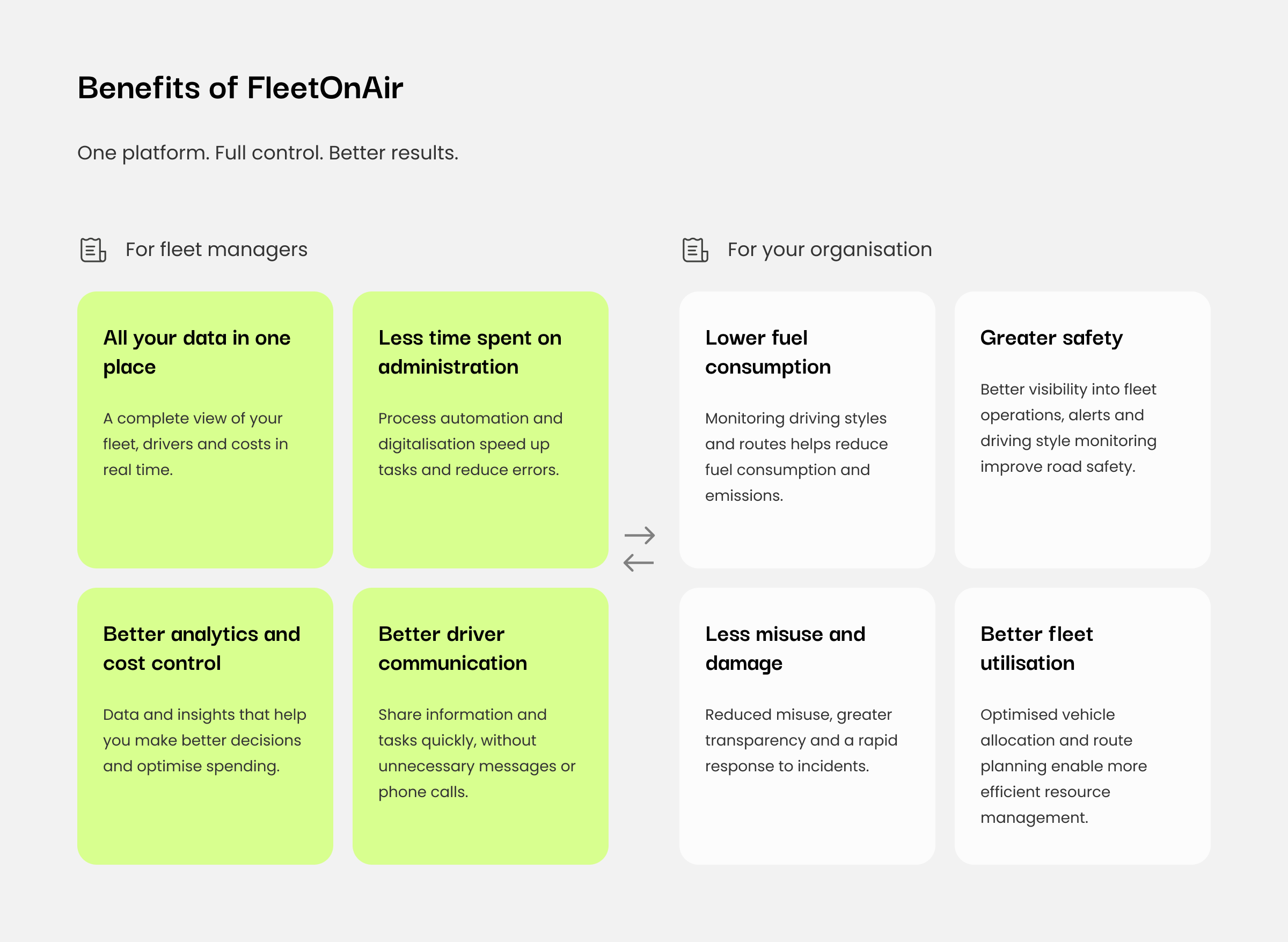
The first group includes benefits for the fleet manager. The platform organises data, reduces paperwork, automates repetitive tasks, improves communication with drivers and allows necessary information to be found faster. The fleet manager does not have to waste time manually collecting documents, searching through emails, tracking deadlines in spreadsheets or recreating vehicle history from several different sources. For fleet managers, this means more organised daily work and easier access to data about vehicles, drivers and costs.
This does not mean that the fleet manager simply has “less work”. Rather, they regain time from low-value activities and can use it for more valuable tasks: cost analysis, searching for savings, optimising fleet policy, negotiating with suppliers, improving safety and long-term planning. This is exactly where comprehensive management software can support the organisation in a real way, because it helps move from reactive work to data-driven management.
The second group includes benefits for the whole organisation. FleetOnAir supports reducing fuel costs, reducing damage, limiting abuse, improving driver safety, making better use of vehicles, increasing settlement transparency and improving control over company assets. The system can also support driver behaviour monitoring, analysis of operational efficiency and detection of areas that require optimisation.
In a broader perspective, the platform helps build a data-driven organisation. Decisions are not based on impressions, but on reports, history, comparisons and specific events. This is especially important where the company’s fleet is an important part of the business model and affects costs, customer service quality, customer satisfaction and operational safety.
The best fleet management software is adapted to the organisation, not forced into one template
One important feature of FleetOnAir is flexibility. It is not only a ready-made, closed product that every company must implement in exactly the same way. The platform can be adapted to the type of business, fleet size, vehicle financing model, company policy, operational needs and organisational structure.
A sales company will need different features than a service company with mobile teams. An organisation using pool cars will have different needs from a company managing a large fleet across many branches. FleetOnAir can grow together with the company — from basic GPS tracking and simple reports to more advanced processes, integrations and administrative cost modules. Depending on the organisation’s needs, it can support both company car fleet management and transport fleet management in road transport.
This flexibility matters because a fleet is always part of a specific business. Technology should adapt to the organisation’s processes, not force the organisation to work according to a random template. Thanks to this, FleetOnAir can be developed as suitable fleet management software for companies that want to implement modern technologies, improve operational efficiency, increase fleet performance and retain full control over their data.
Summary: FleetOnAir as an ecosystem for modern fleet management
FleetOnAir is a platform that combines several key areas of a modern fleet: telematics, mobile application, digital processes, fleet calendar, pool cars, cost analysis, reporting and integrations with external systems. It is a comprehensive fleet management system that supports both daily vehicle handling and strategic fleet management.
Its strength lies in the fact that it does not treat the fleet as a simple set of vehicles, but as a dynamic environment of data, users, costs and processes. GPS tracking provides information, the mobile application connects the driver with the organisation, the calendar organises vehicle maintenance, digital protocols improve documentation security, carpooling improves vehicle usage, and integrations connect fleet data with the wider company ecosystem.
As a result, FleetOnAir supports fleet managers in their daily work and helps organisations better control costs, safety, responsibility and fleet usage. The platform makes it easier to monitor vehicles, analyse data, control fuel consumption, assess driver behaviour and organise work across the entire fleet.
A modern fleet does not need another spreadsheet, another binder or another scattered tool. It needs one platform that turns data into decisions, processes into automation and daily administration into a real operational advantage.
FleetOnAir is exactly such a step — from fleet management based on intuition to fleet management based on data, processes and conscious optimisation.