.jpg)
Allowing employees to use company cars privately is a valued benefit, but for an organisation it can become a source of costs that are not visible in fuel transaction reports alone. The rules governing the personal use of company cars should combine correct tax treatment, a reliable division between business and private journeys, and protection of employee privacy.
The key principle: tax, the private mileage limit and reimbursement of costs are three separate elements. Only by structuring them properly can an organisation create a fair model that can be automated.
Company car tax: income tax and benefit in kind
The Polish Personal Income Tax Act specifies the monetary value of the benefit in kind arising when an employee uses a company car privately. Article 12(2a–2c) of the Personal Income Tax Act sets out how to determine this value. For company car tax purposes, it is added to the employee’s income from employment.
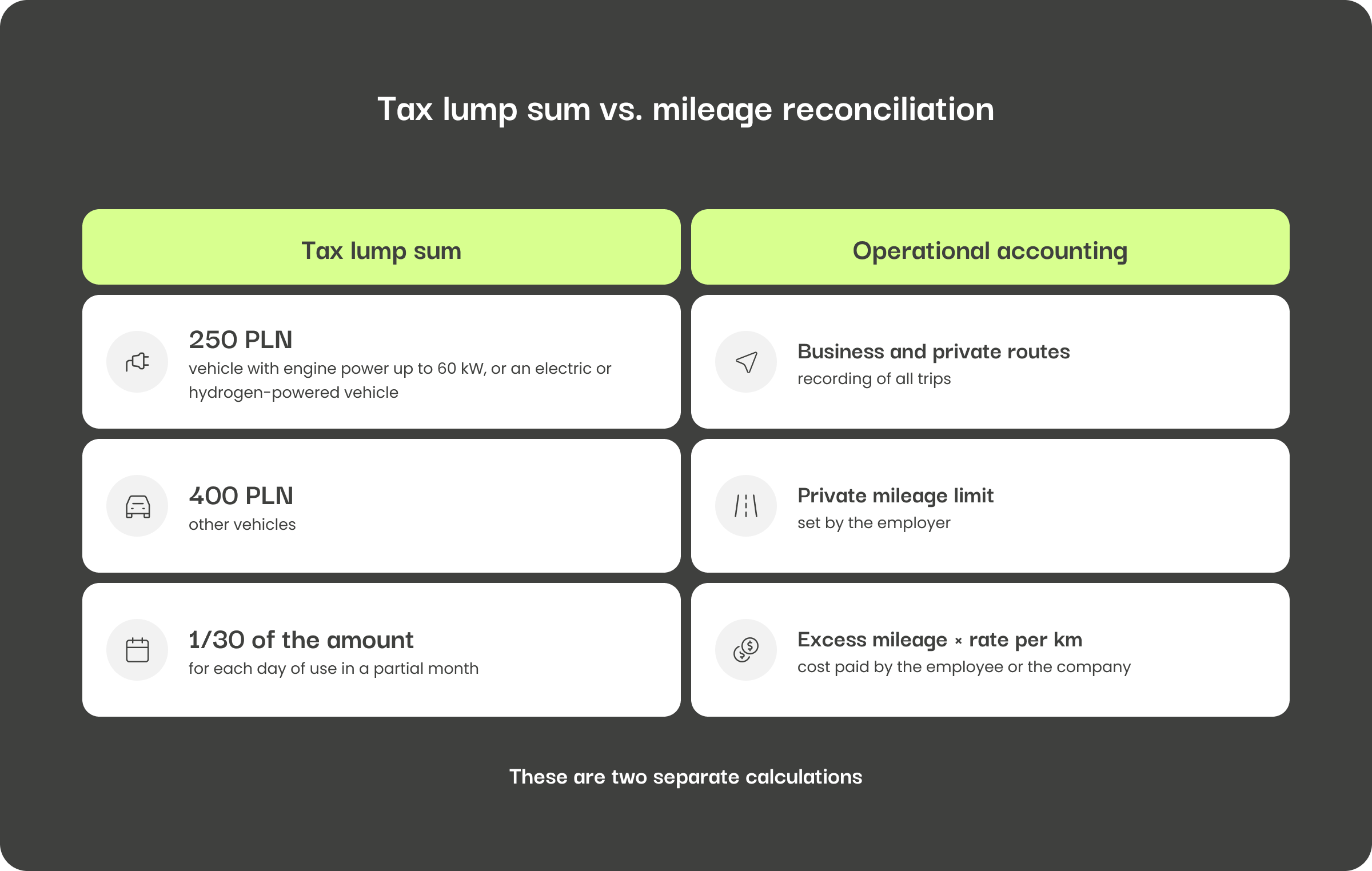
The value of the benefit is PLN 250 per month for cars with an engine power of up to 60 kW, as well as vehicles classified as electric or hydrogen-powered under Article 2 of the Polish Act on Electromobility and Alternative Fuels. For company cars outside this group, the value of the benefit is PLN 400 per month.
Since 2022, engine power has been the determining parameter for company car tax, except where the specific rules for electric vehicles and hydrogen-powered vehicles apply. The flat-rate amount is no longer based on engine capacity or displacement. For electric vehicles and hydrogen-powered vehicles within the meaning of Article 2 of the Act, the PLN 250 amount applies regardless of engine power. A hydrogen-powered vehicle is therefore treated in the same way as an electric vehicle. Its engine power does not affect the amount. For other company cars, the 60 kW threshold applies.
Where a company car is used privately for only part of a month, the value of the benefit is calculated for each day of use at one-thirtieth of the applicable monthly amount. If the employee pays part of the cost of the benefit, the taxable value is the difference between the flat-rate amount and the amount paid by the employee.
The employer adds this monetary value to the employee’s income from employment. For a full month, the value of the benefit in kind for private company car use does not depend on the actual number of private kilometres travelled. Company car tax and the operational settlement of personal mileage should therefore be treated as two separate calculations.
Company car tax and company car policies
The flat-rate value is used to determine the employee’s taxable income. The benefit in kind forms part of the employee’s total income, but company car tax does not determine how many kilometres the employee may travel for personal purposes, who pays for fuel or whether the employer may charge the employee after an agreed mileage limit has been exceeded. These matters should be regulated in company car policies and in arrangements made with the employee.
The benefit in kind arising from the use of a company car should therefore be separated from the operational settlement of mileage. The flat-rate amount relates to the general personal use of a company car, whereas the fleet management system answers different questions: which journeys were made for business purposes, how many kilometres were travelled privately and whether the agreed limit was exceeded. This distinction clarifies both the tax implications and the rules that apply to the employee.
The employer should correctly recognise the employee’s income for company car tax purposes while also defining the rules for personal use of the vehicle. The system does not replace legal or tax assessment, but it provides consistent data on private company car use and makes it possible to complete the settlement within a single process.
Company cars and fuel costs: why a fuel allowance is not enough
In many companies, the personal use of company cars is still controlled through a fuel card limit or a ban on refuelling at weekends and on public holidays. The problem is that a transaction at a petrol station does not reveal the purpose of a journey. A driver may refuel on Thursday, take a long private trip on Saturday and fill up again on Monday. Formally, the driver has not broken the rule prohibiting refuelling on non-working days, but the organisation still bears the cost.
Fixed fuel limits can also be unfair. Two cars may have very different fuel consumption, while employees may travel routes of a completely different nature. The same amount available on a fuel card therefore does not provide the same level of mobility in every company car. Moreover, manually combining fuel card data, mileage records, holiday information and driver declarations takes time and increases the risk of errors. As a result, the employer does not obtain reliable information about how company cars are actually used for private journeys or about their total mileage.
Actual private mileage provides a better point of reference. It is the kilometres travelled, rather than the moment when fuel was purchased, that generate operating costs, contribute to tyre and component wear, bring forward servicing and may cause the mileage limit in a lease agreement to be exceeded. Accurate mileage records therefore provide a more reliable basis for settling company car use than fuel transaction values alone.
Fuel costs and the maintenance of a company vehicle
The costs financed by the employer in connection with the general use of a car extend beyond fuel. In practice, the employer also covers routine repairs, scheduled inspections, tyre and oil changes, and other consumables. The greater the vehicle’s private mileage, the sooner further maintenance costs arise.
The rules governing fuel costs should be defined separately from both the tax flat rate and the mileage limit. The employer may decide which vehicle operating costs are covered as part of the employee benefit and which are charged to the employee. This prevents fuel purchases, scheduled inspections and other company car costs from being treated as one unclear expense category. The mileage of the company car remains the primary parameter for operational settlement.
Comparing the cost of different cars requires reference to mileage rather than fuel expenditure alone. For vehicles with different weights, powertrains and use patterns, the same distance may generate different costs. Vehicle data should therefore be analysed within comparable groups, such as service vehicles, management cars, pool cars and electric vehicles. Comparing vehicles used for similar purposes produces a more reliable result than combining all cars in a single analysis. This division does not change the rules laid down in personal income tax legislation, but it makes it easier to budget for vehicle maintenance and assess the actual cost of the employee benefit.
Automatic mileage tracking for business and private journeys
This is where the capabilities of fleet policies, driver declarations and spreadsheets come to an end. FleetOnAir provides automatic mileage tracking by translating the rules governing the use of a company vehicle into classification rules applied to every journey. The system combines work schedules, information about non-working days and absences, and driver corrections to distinguish business mileage from private mileage. Journeys are logged automatically, so the settlement does not have to be reconstructed manually at the end of the month.
The greatest challenge in mileage tracking is correctly identifying the nature of a journey, rather than merely counting kilometres. FleetOnAir automates standard cases while leaving drivers to handle exceptions. As a result, most journeys made in company cars are classified without involving the fleet department, while an unusual trip can be explained and corrected through a controlled process.
From journey to settlement: FleetOnAir combines automatic mileage tracking, privacy protection, mileage limits, driver corrections and monthly summaries in a single workflow.
Layer 1: work schedules and business mileage
The first layer of FleetOnAir automation is the schedule in force within the organisation, for example Monday to Friday during specified work hours. Journeys made within this time window are provisionally classified as business journeys, while all others are classified as private. The rule should reflect the company’s policy, including the way journeys between an employee’s home and workplace are classified. This ensures that business mileage is recorded according to rules known to the driver, rather than assumptions made after the month has ended.
A single schedule is not sufficient in an organisation with shift work, business travel, flexible working hours or on-call duties. FleetOnAir can use individual variants assigned to drivers, as well as rules assigned to vehicles. A service vehicle may operate under a different model from a management car, while a pool vehicle intended solely for business purposes may remain permanently in business mode. The rules governing the use of a company car should also cover commuting. The employer should describe these differences in the fleet policy or other applicable internal regulations.
Layer 2: calendar and absences
The second layer consists of information about statutory public holidays and planned absences. Once FleetOnAir has been supplied with the necessary data, the system can automatically apply private mode when an employee uses a company car while on annual leave, regardless of standard working hours. This classification method supports the settlement of private company car use, but the integration should transfer only the data that is necessary, without revealing the broader context of the absence.
Layer 3: corrections in the driver app
Automation must account for exceptions. In the FleetOnAir driver app, a period of private company car use, such as annual leave, can be marked in advance. A journey can also be corrected after it has ended. If a business trip begins at 5:00 a.m. but the company’s standard working hours start at 7:00 a.m., the journey will initially be classified as private. Once its category has been changed to business, FleetOnAir retains a record of the correction and enables it to be verified.
This workflow reduces the number of emails and manual reports sent to the fleet department. At the same time, FleetOnAir’s change history creates an audit trail showing who changed the journey category, when it was changed and how. This is important both for settlement transparency and for limiting misuse.
GPS tracking and driver privacy for personal journeys
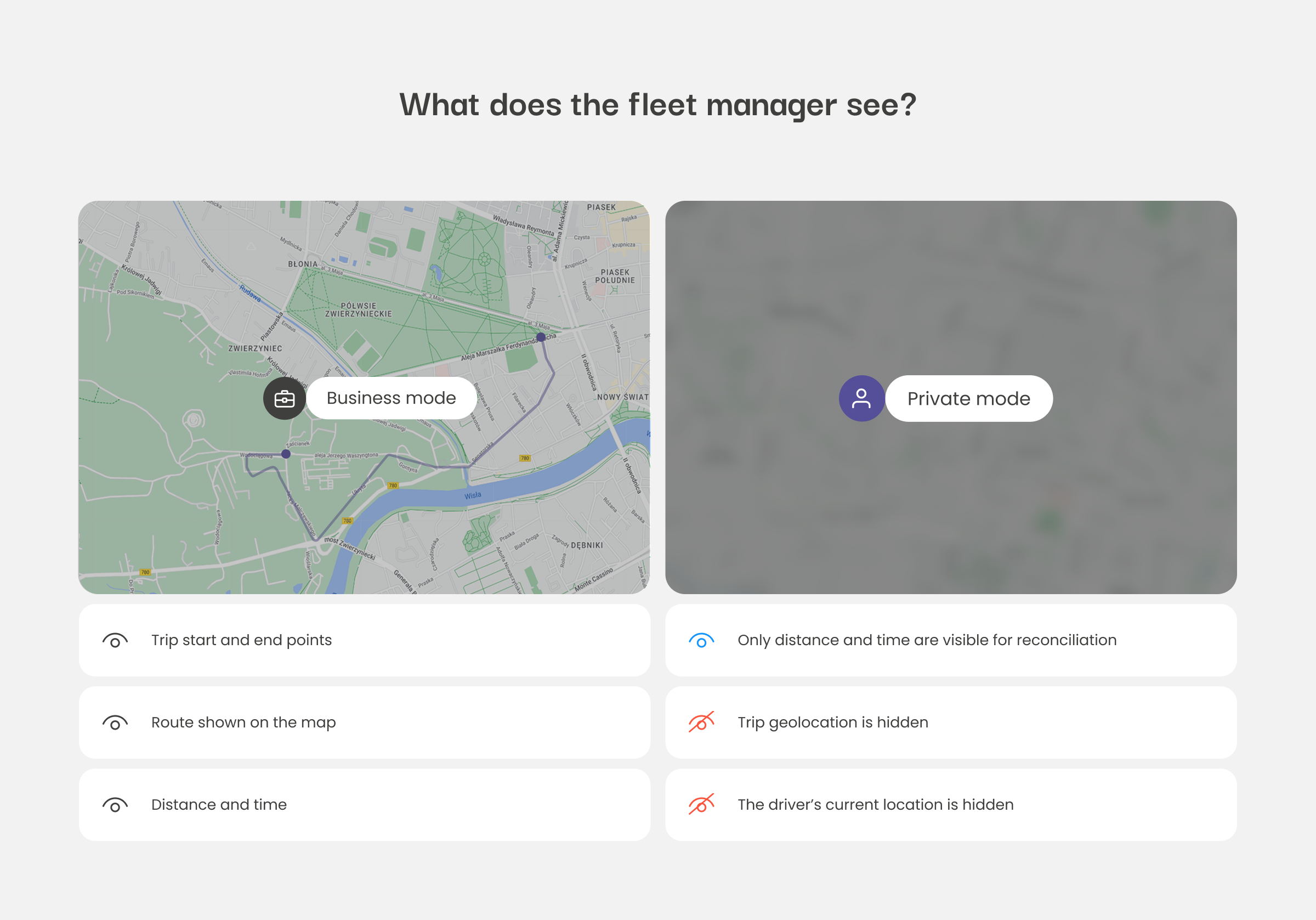
GPS tracking of company cars should not mean that fleet managers can see where an employee spends evenings, weekends or holidays. In FleetOnAir, personal journeys can conceal the precise start and end points, as well as the route on the map, while retaining the data required for settlement, such as the distance and time of the journey. In this way, protecting employee privacy does not prevent the organisation from determining the number of kilometres for which the employee is responsible.
If a driver changes a journey’s category from private to business, FleetOnAir may disclose to an authorised person the information required to verify the correction. Roles and permissions should restrict access, while the data retention period should be limited to the justified minimum. An employer should not obtain a broader picture of an employee’s private life simply because company cars may also be used outside business purposes. Employee and vehicle data must remain accessible only to the extent necessary for settlement.
Concealing the geolocation of personal journeys supports the data minimisation principle set out in Article 5 of the GDPR. The FleetOnAir feature supports this principle, but it does not in itself determine the compliance of the entire GPS tracking process. The employer should define the purpose and legal basis of the processing, inform employees about the monitoring rules, establish the scope of access and describe the solution in the relevant internal regulations.
Mileage tracking app: from private journeys to monthly settlement
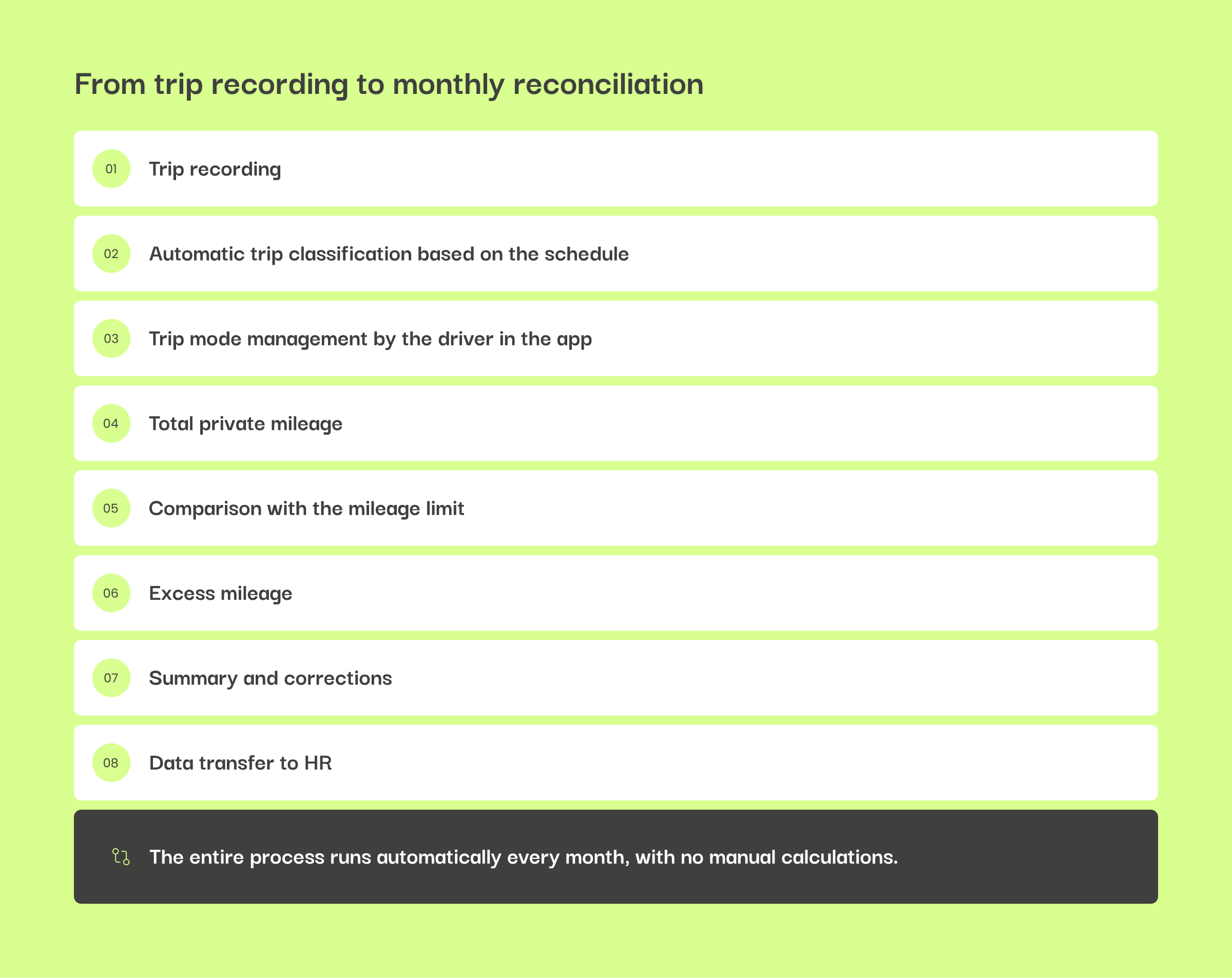
Once journeys have been classified, FleetOnAir totals the private mileage and compares it with the agreed private mileage limit. The limit may be the same throughout the organisation or vary according to transparent rules, such as the scope of benefits assigned to the employee’s position. Before the settlement period begins, the employee knows the limit, the rate per kilometre and the procedure for making corrections. The FleetOnAir mileage tracking app provides the driver with a clear summary of the data on which the employer bases the calculation.
For example, with a monthly limit of 300 km, a driver travels 420 km for private purposes. FleetOnAir identifies 120 km in excess of the limit. If the agreed rate is PLN 0.50 per kilometre, the amount due is PLN 60. The excess is calculated automatically from the mileage records. At the end of the month, the employee reviews the list of journeys in the app, makes any necessary corrections and approves the result. The approved data can then support payroll processing and tax reporting.
If the amount is to be deducted from the employee’s salary, the requirements of Polish labour law must be observed. Article 91 of the Polish Labour Code states that amounts other than those listed in Article 87 may be deducted only with the employee’s written consent. Statutory minimum amounts protected from deductions also apply. FleetOnAir automates the preparation of the summary, corrections, approval and transfer of data to HR and payroll. The entire process takes place through the mobile app. The system automatically reminds the driver to approve the monthly settlement and regularly notifies them of the approaching approval deadline. This eliminates the need to prepare paper documents or manually sign declarations.
EcoDriving and flexible Pay-as-You-Drive rates in FleetOnAir
The simplest model applies a single rate to every kilometre above the agreed limit. FleetOnAir makes it possible to extend PAYD by incorporating an assessment of driving style. A driver who drives smoothly, follows traffic regulations and avoids sudden manoeuvres may receive a more favourable rate. A driver whose journeys generate more high-risk driving events may be charged a higher rate for excess mileage, provided that the organisation has adopted such rules.
For example, 100 km above the limit may cost PLN 30 at a rate of PLN 0.30 per kilometre or PLN 80 at a rate of PLN 0.80. The difference is easy to understand and has a direct impact on the driver. In FleetOnAir, driving style assessment then ceases to be an abstract score in a report and becomes part of everyday motivation. Events recorded on the road must also be described in a way that employees can understand.
Such a mechanism requires particular transparency. Employees must know which events affect their assessment, how the thresholds are set and how they can challenge incorrect data. The criteria configured in FleetOnAir are the same for each comparable group of drivers. Employee obligations cannot be based on an undisclosed algorithm. Otherwise, the incentive system will quickly be perceived as an arbitrary penalty.
Business mileage, private mileage and fuel costs
EcoDriving is associated primarily with reducing fuel consumption. Business mileage and personal mileage must be classified separately, and in a pay-as-you-drive model, reducing unjustified private mileage is particularly important. FleetOnAir bases settlement on journey data because every additional kilometre means not only fuel consumption, but also faster wear of tyres, brakes and components, more frequent servicing, a decline in the vehicle’s residual value and the risk of charges for exceeding the mileage limit in a lease agreement.
When FleetOnAir automatically identifies private mileage and settles it according to clear rules, there is less scope for private company car journeys that the company does not intend to finance. The fleet manager gains a more complete view of the costs assigned to a vehicle and its user, while the employee benefits from predictability and the ability to verify the data independently before the month is closed.
How fleet managers can implement Pay as You Drive
Define the objective and process owner
First, the employer should determine whether the organisation wants only to measure private mileage, introduce a limit, charge for excess mileage or additionally reward safe driving. Only then should this model be configured in FleetOnAir. The process should have a single owner, but it requires cooperation between fleet management, HR and payroll, finance, IT and data protection teams.
Define the journey classification rules
Standard working hours, rules for shift work and business travel, the treatment of commuting, and exceptions for individual vehicles must be defined. The same rules should then be configured in FleetOnAir. The employer should set out the rules governing private use of company cars in the fleet policy, an agreement or other applicable internal regulations. The system settings must reflect how the vehicles are actually used, rather than merely a theoretical schedule.
Set limits, rates and correction rules
The fleet policy should clearly specify the monthly limit, the method for calculating excess mileage, the deadline for corrections and the point at which the settlement period is closed. These parameters can be configured in FleetOnAir so that employees understand how the employer settles the personal use of company cars. If the rate depends on driving style, transparent thresholds and access to the score used in the calculation are essential.
Build privacy into the process from the outset
FleetOnAir should be configured to restrict the visibility of private journeys and grant permissions only to people who genuinely need access to the data. The organisation should also define the retention period and prepare clear information for drivers. Concealing geolocation is one element of the overall data protection framework, rather than the only safeguard. The employer should explain to employees which vehicle data remains visible in private mode.
Complete the entire workflow within a single process
The greatest value comes from using FleetOnAir as a shared workflow for journey classification, driver corrections, calculation of the amount due, approval and reporting to HR and payroll. Data on private company car use, the employee’s taxable benefit and any amount owed to the employer all come together within one process. The legal basis for a salary deduction remains outside the system’s role. However, if journey data, corrections or reporting remain outside FleetOnAir, the organisation returns to emails, spreadsheets and manual data comparison.
Run a pilot and measure the results
Before implementing FleetOnAir across the entire fleet, fleet managers should conduct a pilot involving different vehicle groups and working models. The number of vehicles should make it possible to test the rules for service vehicles, management cars and pool cars without creating an arbitrary mix. During the pilot, the organisation should monitor the number of incorrect classifications, the time required for corrections, private vehicle mileage, operating costs and employee reception of the rules. These findings support informed decisions about schedules and thresholds for individual vehicle groups.
FleetOnAir: from fleet policy to automated settlement
The pay-as-you-drive model brings structure to an area that remains imprecise in many fleets: the private use of company cars. FleetOnAir takes the organisation from a rule written in its internal policy to accurate records ready for monthly settlement. Instead of monitoring fuel purchases and analysing exceptions manually, the employer uses mileage tracking, schedules, an absence calendar and corrections entered by drivers. This makes it possible to determine the benefit in kind associated with company cars consistently and settle private mileage separately.
The most important outcome is not the calculation of the charge itself. FleetOnAir completes the operational part of the process within one clear workflow: from identifying the type of vehicle journey, through privacy protection and verification of exceptions, to the monthly summary and report. Clear rules reduce disputes, improve control over vehicle mileage and ensure that employees understand in advance the consequences of using a company car for private purposes. The same principles can be applied to different vehicle groups while retaining separate schedules and mileage limits.
FleetOnAir combines journey classification, a mileage tracking app, privacy protection for location data, private mileage limits, reporting and driving style analysis. As a result, settling the personal use of company cars becomes part of day-to-day fleet management rather than a monthly paperwork exercise.