A valid driving licence, valid driving entitlements, an up-to-date vehicle inspection and continuous motor third-party liability insurance are essential requirements for the safe use of a company vehicle. When employers manage dozens or hundreds of drivers, manually checking every document soon becomes insufficient. Integration with CEPiK, Poland’s Central Register of Vehicles and Drivers, turns driver licence checks into a recurring process that runs in the background.
Why does driving licence status require regular checks?
Driver and vehicle details are constantly changing. Vehicle inspection deadlines draw closer every day, motor third-party liability insurance policies have defined coverage periods, and an employee’s licence status can change without the fleet department being aware. A driving licence may expire or be retained by the authorities, while a driver’s entitlement to drive vehicles in a particular category may cease to be valid.
A scanned driving licence or a date recorded when an employee joins the business only reflects the situation at a particular moment. Neither confirms whether the employee still holds a valid licence and the entitlements required to drive. Simply keeping a copy of a driving licence is not enough if employers need to verify its current status.
It is also worth remembering that driving without valid entitlements may provide grounds for rejecting a claim under comprehensive motor insurance (known as AC in Poland). This is one of the standard exclusions set out in insurance terms and conditions, and its application depends on the wording of the specific policy and the circumstances of the incident. Regular driver licence checks therefore also help reduce financial risk for the business.
In a small business, checking a few people through a public portal is not a significant burden. The challenge arises when there are 50, 100 or 200 drivers. The more employees use fleet vehicles, the greater the need to regularly monitor licence validity and confirm whether each driver can continue to perform duties involving driving. Whether a driver is still legally entitled to drive is one of the most important questions in the day-to-day management of drivers and company cars.
Driver licence checks also matter for the legal responsibility of those who release vehicles to drivers. A dispatcher who, even unintentionally, allows someone without the required driving entitlements to drive a vehicle on a public road may be liable for a minor offence under Article 96 § 2 of the Polish Code of Petty Offences. This may result in a fine, which is why a licence check should be a routine part of the process for making fleet vehicles available to employees.
The Central Register of Vehicles and Drivers as a data source
Poland’s Central Register of Vehicles and Drivers (CEPiK) holds information about vehicles, documents and driving entitlements. For fleet managers, the key details cover two areas: vehicle status and whether drivers hold valid entitlements to drive. Information from the central register supports driver licence checks without the need to maintain separate driver records.
The FleetOnAir integration currently under development uses data from the central register of vehicles and drivers to reduce manual record updates. Through this integration, the system can carry out periodic driver licence checks, update information and provide results to those responsible for the fleet. The scope of each licence check is then consistent across the entire group of drivers.
The benefit therefore goes beyond access to the central register. The greatest value comes from connecting a reliable source with the business’s monitoring process. As a platform used to manage drivers and vehicles, FleetOnAir should not only display the results of a licence check but also highlight changes that require action. This level of automation increases its value while keeping the process within the scope of the data available in the register.
CEPiK integration: vehicle details, inspections and insurance
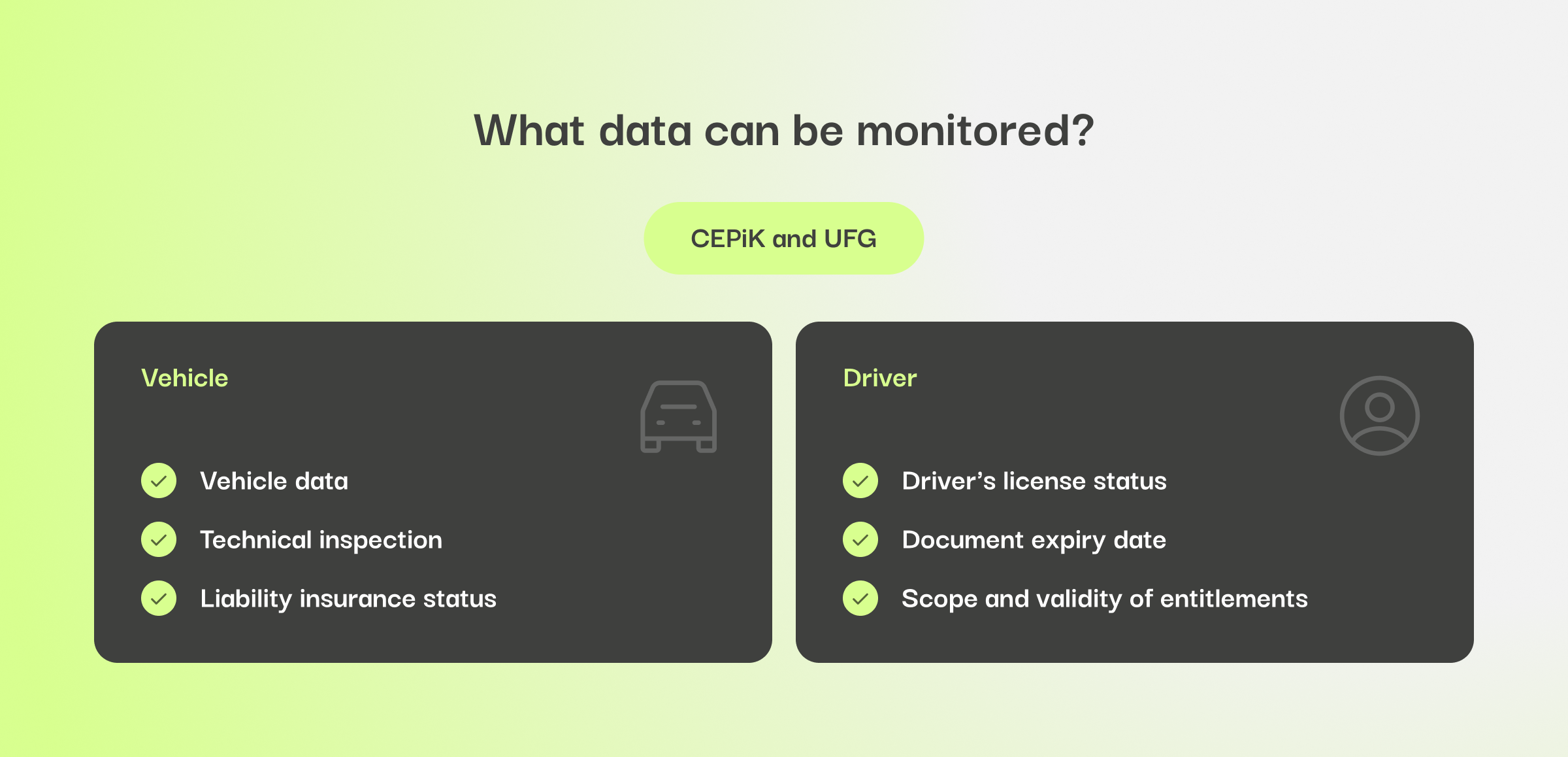
The first area of integration concerns vehicles. FleetOnAir retrieves and updates details about vehicle inspections, policies and insurance coverage. Motor third-party liability insurance information is linked to data from the Polish Insurance Guarantee Fund (UFG). The integration gives fleet managers a consolidated view instead of several separate sets of records. Linking drivers to vehicles makes it easier to access the relevant record.
Automation reduces the risk of an employee entering an incorrect date or failing to update a record after a document changes. Monitoring expiry dates makes it possible to provide advance notice of an upcoming vehicle inspection or the end of insurance coverage. The solution does not fulfil the fleet department’s responsibilities on its behalf, but it reduces the need to check each vehicle manually.
Driver licence checks: verifying a driving licence online
The second area is the verification of driving entitlements. The public “Sprawdź uprawnienia kierowcy” (“Check a driver’s entitlements”) service allows users to check a driving licence online using details from the document. To use this service, they need the driver’s surname and driving licence card serial number. In an automated process, the API service uses the same details. The service generates a response based on the current information held in the register.
The response may include licence status, the document’s expiry date, the licence categories the driver is entitled to drive and their expiry dates, as well as information on whether the document has been retained by the authorities. These details are needed to assess whether the driver’s entitlements still cover the vehicle categories required within the fleet. The licence check result allows the document’s status and the driver’s entitlements to be reviewed together. Each response returned by the service should be interpreted in the context of the individual driver’s duties. Any information indicating that driving entitlements have been suspended should be verified by the fleet administrator.
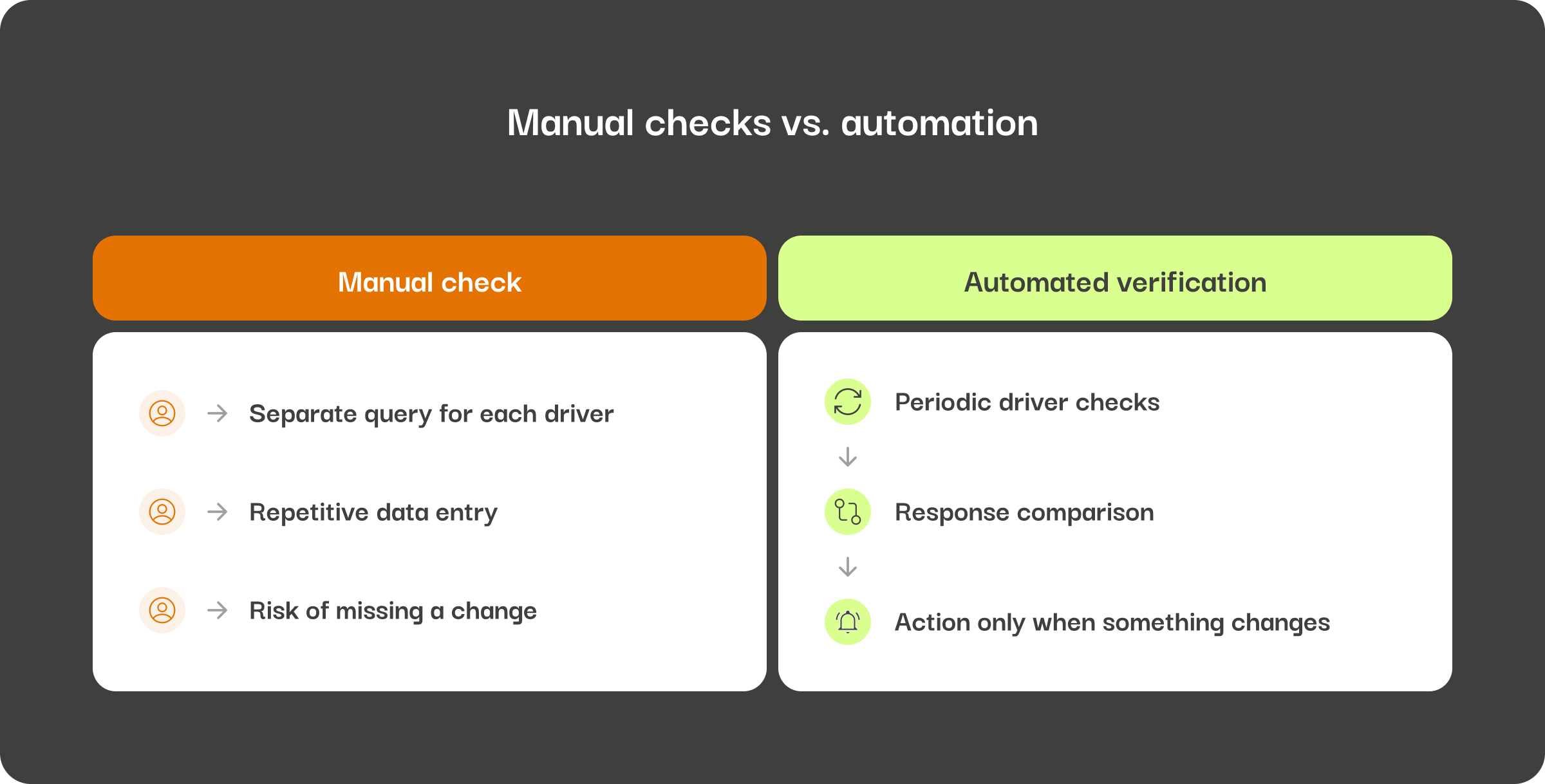
Automated checks replace a series of individual queries with a recurring process. This removes the need to log in to the portal every day and manually compare licence check results for each employee. Automating verification does not change the scope of the data; it makes the service easier to use. In the manual approach, each licence check is performed individually. After integration, the service is called periodically, for example once a day.
Driving licence check requirements: the card serial number and document details
The card serial number is an identifier printed on the document. This driving licence card serial number, together with the driver’s surname, makes it possible to submit a query. The accuracy of these details is essential: an incorrect card serial number or a surname mismatch may prevent a successful licence check. The correct surname is particularly important for women who have changed their surname following a change in marital status but have not replaced their driving licence.
Manual checking: why does it become harder as the fleet grows?
The “Check a driver’s entitlements” service is sufficient when a business monitors only a few people. With more drivers, every licence check requires someone to enter the details, read the response and compare it with the previous driving licence status. If employers carry out these checks daily, this creates a substantial admin burden. Checking frequency directly affects the workload. Manual driver licence checks require increasing amounts of work, making the process less efficient as the fleet grows.
In practice, manual checking is also prone to inconsistent procedures. One employee may check a driver’s entitlements every week, while another may do so only before handing over a car. Automated checks introduce a consistent schedule and the same scope of verification for all drivers. Uniform rules make it easier to compare licence check results.
Scale has a direct impact on efficiency. When organisations have hundreds of vehicle users, manually checking driving licence status takes time away from other tasks. Automation not only reduces the time spent on this work but also improves efficiency, as the fleet team focuses on exceptions instead of repeating the same manual processes.
How does FleetOnAir carry out a licence check and send automatic alerts?
Implementation starts with completing driver records. When a driver’s account is activated, the system asks for the driving licence card serial number. These details can also be entered manually at a later stage. The business must also complete the process to obtain an access certificate, which enables the CEPiK API integration to operate on the client’s behalf. The configuration also determines which drivers are included in the licence check process.
Once configured, the system runs queries automatically, for example every night. Each licence check covers the driver’s entitlements, the document’s status and driving licence validity. The response is compared with the previous day’s status, allowing the system to detect changes without manually reviewing every record.
If the document is marked as retained by the authorities or the driving licence expires, FleetOnAir sends a notification to the fleet department. Alerts may also concern expired driving entitlements. The loss of driving entitlements is treated as a change that requires verification. The system flags the issue, but the company remains responsible for deciding whether the driver may continue to drive.
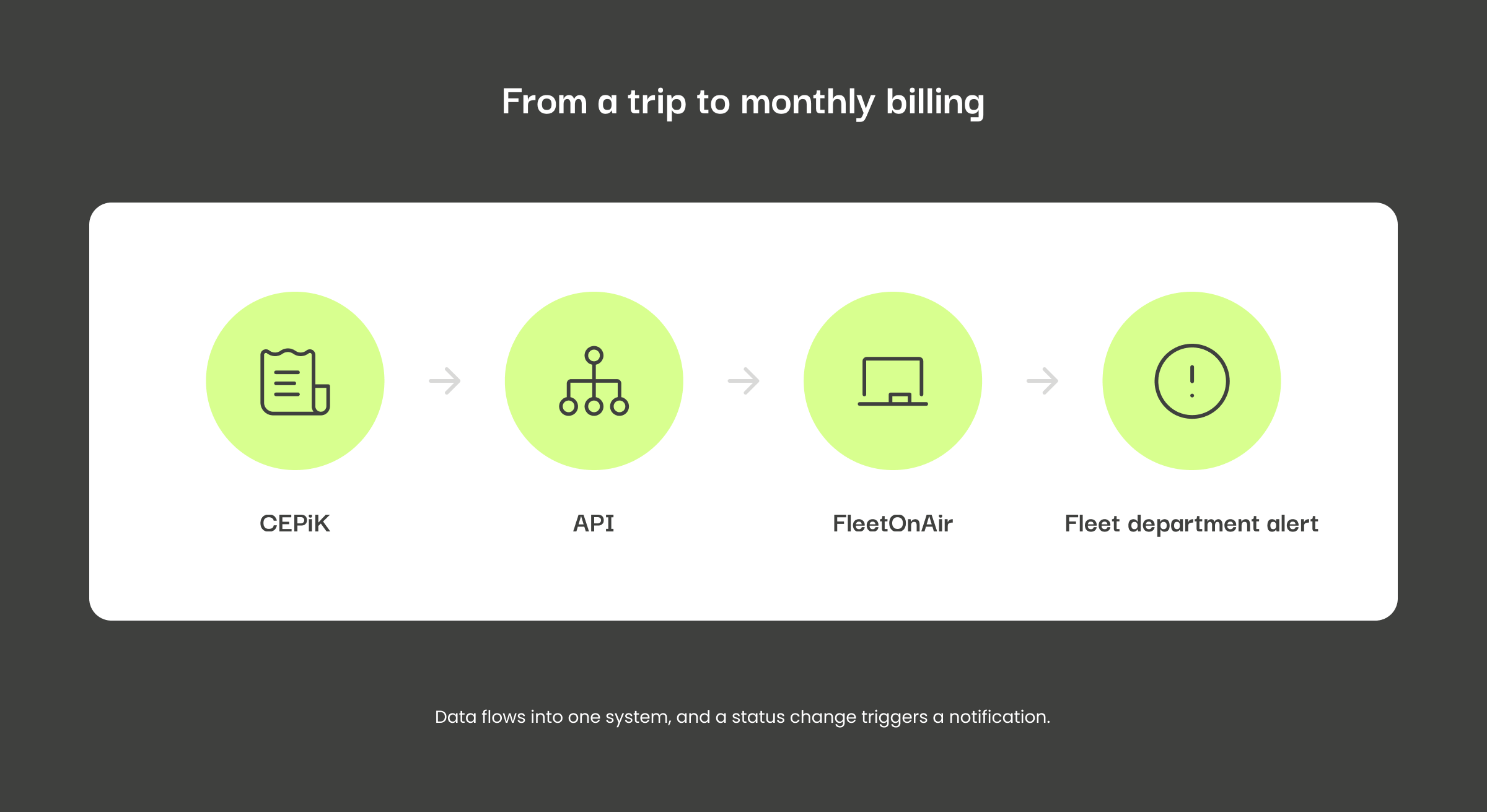
Integration turns driving licence checks into a structured process
Automated driver licence checks reduce repetitive tasks. The fleet team no longer needs to open the “Check a driver’s entitlements” service every day, enter details and record each response. The system performs the licence check, and an employee only needs to respond when a change occurs.
Prompt information about a retained or expired driving licence reduces the risk of a vehicle being entrusted to someone without valid driving entitlements. Regular checks support the safety of drivers, other road users and the entire fleet. Faster responses improve road safety, although the service itself does not replace business procedures. A licence check that confirms the scope of an employee’s driving entitlements before they are allowed to drive a car further reduces road risk.
Every licence check follows the same rules and uses the same scope of data. This makes it easier to monitor whether drivers hold a valid licence and the required entitlements, regardless of who is responsible for the fleet. Through integration, information about drivers and vehicles is available in one system. Users can view licence check results without switching between several tools.
Implementing CEPiK integration: licence check procedures and responsibility
Before activating the functionality, check that driver records are complete. The driver’s surname, card serial number and vehicle assignment must be correct. Employers should also define who receives alerts, who confirms licence status and who makes decisions when a change is detected.
Automation does not remove the business’s responsibility to respond. The system supports monitoring and provides key information, but a fleet department employee should investigate any unusual licence check response. If there is uncertainty about a document’s status, it is necessary to verify the details and contact the driver.
It is also important to establish how frequently queries will be made. Daily driver licence checks provide prompt access to changes, but the schedule should reflect the business’s size and way of working. A well-designed implementation improves efficiency without generating excessive alerts. Those responsible for operating the system should know how often verification takes place. Licence check procedures must also define how alerts are handled.
From a driving licence check to active fleet risk management
The greatest value of the solution lies in more than retrieving data from the register. What matters is connecting information with a process: the system performs a licence check, compares the result with the previous status, detects a change and notifies the appropriate employee. Driver entitlement verification therefore becomes an ongoing part of fleet management. The solution structures driver licence checks while leaving decisions in human hands.
Connecting to CEPiK allows the fleet team to shift its attention from manually transcribing details to cases that require a decision. The larger the fleet, the clearer the benefits: more efficient monitoring of entitlement validity, up-to-date driving licence status and faster responses when a driver’s entitlements cease to be valid. For the business, this means fewer routine tasks and quicker identification of exceptions.
Want to introduce automated driver licence checks across your fleet?
Contact the FleetOnAir team. We will help you prepare the data, arrange API access, define monitoring rules and configure alert scenarios related to driving licence status.


.jpg)